Saturday, April 9, 2011

Updates

1. I think it's funny how Donald Trump has gone around publicizing the so-called "birther" notion that Barack Obama is not a "natural born citizen" of the United States and is therefore ineligible for the office of president of the country.  I regard it as a moot point -- no matter what came to light at this late juncture, no federal court in the country would purport to disqualify Obama from the office he's occupied for the last two-plus years.  (And I learned long ago that the Constitution says or means no more, and no less, than the U.S. Supreme Court says it does.)  What is annoying to me, however, is that any Republican presidential candidate whose citizenship status was the least bit in question would have been hammered about it in the media long before he was elected president.  The double standard is both obvious and ominous.  (As regards Obama, I'd much rather see his SAT and LSAT scores, together with his transcripts from Occidental College, Columbia University and Harvard Law School, than his long-form "certificate of live birth."  I, like millions of others, would like to see if his academic record truly reflects his putatively prodigious intellect, or if his various schools gave him a pass -- his serving as editor/president of the Harvard Law Review without authoring so much as a case note, much less an in-depth law-review article, being one strong indication that such was the case -- much like the media did during the 2008 election campaign.  If any of the aforementioned documents is ever released publicly, I'll be amazed.)

2. Dorine and I have lived in our home now for twenty years, and we recently paid off our first mortgage (which we'd re-financed twice in the interim due to falling interest rates).  It took only twenty years to pay off our house because of one reason -- from the time we moved in, we paid $100 in "extra principal" every month on our mortgage payment.  It's astounding, looking back, that that one thing lopped off ten years of payments -- without adjusting for the time value of money, we paid $24,000 to save roughly $80,000 -- but such is the power that accruing interest holds, either for good or for ill.

3. Dorine and I have started working at the temple as ordinance workers -- again, in my case -- on the even-numbered Wednesday evenings.  I don't feel any better from the afflictions that caused me to ask to be released from the temple last October, but working only two shifts per month now is much more manageable for me than was working every week.

4. For all the diagnostics that have been performed on me since I fell ill following our Caribbean cruise in January 2010, nothing definite has been found to be wrong with me.  Recent blood work showed my liver enzymes to be sharply elevated, which would normally indicate hepatitis of some kind; indeed, I was having gastrointestinal issues of the same sort I had in 1980 when I was diagnosed with Hepatitis 'A' while serving my mission in Chile.  However, a hepatitis screen came back negative for all varieties of hepatitis, and just yesterday I had blood drawn for another hepatic function test.  If my enzyme levels are still high, I'm probably looking at having an ultrasound done of my liver; in addition, I'm having a "routine" colonoscopy done at the latter part of this month.  It will be interesting to see if either of those procedures shows anything seriously amiss.  I've also wondered if I could have some kind of persistent parasite that I picked up in the islands -- except that most parasites cause people to lose weight, whereas I've actually put on 20-25 extra pounds since the cruise.  I still ponder what could be causing my health issues, but I've come to the point where I can no longer distinguish cause from effect.  Two years ago, my sleep disorder was still my chief complaint; if only that were still my biggest health problem!

5. My nephew Aaron P_______ has now come home from his mission to Russia, and he'll shortly be going back to school at BYU-Idaho.  Hopefully, he'll have a chance to see Darren -- who, for the time being, is still in Provo -- on the way to Idaho.  The two have not seen each other in over three-and-a-half years now.  Darren will be working here this summer at Sandia National Laboratories, and I look forward to having him here for an entire summer for the first time since 2007.

Sunday, March 27, 2011

KCGL - "Modern Music" Radio Station
in SLC (1983-86)


I was thinking the other day about KCGL, an FM radio station in Salt Lake City that was a cutting-edge "modern music" station circa 1983.  (I vaguely remember the call letters "KABE" and thus believe that KCGL may have been preceded by KABE as the "alternative" station in the area; however, for present purposes I'll lump them together.)  I first became aware of KCGL when I went and spent a few days in August 1983 with my friend Bob Maes and his parents and siblings in Sandy, UT.*  Bob was always more informed than I about popular music, and he had me start listening to KCGL while I was there.  The station was a revelation, as I'd never before heard such interesting music, and from such obscure artists, on commercial airwaves -- and it seemed to be a going concern and very popular with young people on the Wasatch Front.  To give some context to this phenomenon, I try to imagine a radio station today, virtually anywhere, playing nothing but the newest, hippest indie-rock music; it just couldn't be, because any business-feasibility study would predict failure due to lack of advertising revenues.

Anyway, for the next couple of years Bob periodically recorded bunches of songs off KCGL and sent them to me on cassette tapes, and I was always grateful to get them.  Ultimately, however, KCGL did fail; I'm not sure when or precisely why -- although the rise of hip-hop and grunge-rock, together with the growing popularity of "classic rock" formats, probably contributed to its demise.  (I'm not sure how it maintained a core of advertising clients as long as it did, when its ever-changing playlist was so far out front of the usual crap one heard on the radio.)  It's common to look back now on the 80s and laugh about what was popular then -- I chuckle when I remember how Bob's younger sister Monica and her friends wore men's pajama bottoms, with the flies sewn shut and the legs tucked inside stockings, in lieu of pants -- but some of the "modern music" from that era is still very interesting.

The foregoing Youtube embeds contain songs that I like even now, all of which I first heard on KCGL during that stay with Bob and his folks in 1983: (1) "The Animal Song" by the Europeans; (2) "All Lined Up" by Shriekback; (3) "(If You Ask Me) I Won't Say No" by Pete Shelley; and (4) "Guitar, Talk, Love and Drums" by Gary Myrick and the Figures.  I like the two live performances (which thankfully sound very different from the studio versions of the songs) a lot better than the two execrable music videos -- the latter "art" form being one of the truly lamentable fixtures of the 80s music scene -- but it's all good.

* Bob grew up in Albuquerque and, though we hadn't known each other previously -- having grown up on opposite sides of town and in different stakes -- we roomed together as freshmen at BYU in the 1977-78 school year, and, later, for an additional semester in 1981 after our missions. Bob left on his mission to Argentina in December 1978 from the Albuquerque 5th Ward (which at that time took in the entire North Valley and the West Side north of I-40, an area that now encompasses 2+ stakes by itself); however, shortly thereafter his father took the job of postmaster of Sandy, and thus Bob went "home" from his mission to Utah.

[Update 3/31/11: It appears from information available on the Internet that KCGL passed from existence as a New Wave station, and adopted a "Christian rock" format, sometime in 1986.  (Apparently another SLC-area station, KJQN, then picked up the "alternative music" gauntlet for a few years, but that's beyond the scope of my experience.)  I'm sure it was a decision primarily driven by finances, but it's difficult to say which was more incongruous with being located in the demographic/political center of the Mormon Church (KCGL's broadcast facility was apparently located in Bountiful/Centerville to the north) -- a gritty "modern music" radio station or a schmaltzy "Christian rock" radio station.]

Sunday, March 20, 2011

Random Thoughts, Part 6

1. I've become convinced that the federal government's energy policy -- to the extent it has a coherent policy -- has as its sole purpose to drive up energy prices and inflict pain on the citizenry.  Given that our government is supposed to be "for the people," that's a remarkable conclusion to draw.  We're seeing unabated assaults on the internal combustion engine, which is still the key to affordable private-vehicle ownership.  And the greatest freedom an American citizen has is the ability to get in his car and go anywhere his time and resources allow.  However, the Obama administration's stated goal, which cannot be for the purpose of increasing mobility or driving down transportation costs, is to create access -- unprofitable, costly access -- to high-speed rail for 80% of the population.  I regard it as fair to infer from that goal that the government means to restrict mobility by limiting transportation options, essentially so that it can ultimately tell most of us where we can go and when.  The interstate highway system, which greatly increased mobility and drastically reduced the costs of transporting freight by truck, is generally viewed as one of the crowning achievements of the Dwight Eisenhower administration (1953-1961); however, I suspect strongly that if these highways didn't already exist, the Democrats would do all they could now to prevent their being constructed, favoring localized rail lines instead.  Recall this exchange between Sam Neill and Sean Connery, playing Soviet naval officers in the film The Hunt for Red October (1990) and discussing what it will be like to live in America after defecting:
Borodin [Neill]:  [A]nd I will have a pickup truck, or possibly even a...recreational vehicle...and drive from state to state. Do they let you do that?
Ramius [Connery]:  Yes.
Borodin [Neill]:  No papers?
Ramius [Connery]:  No papers. State to state.
I reiterate: Mobility, and the liberty it represents, is a hallmark of an even moderately free society.  High fuel costs, which are largely a function of supply, or rather perceived supply -- which in turn is affected by Middle-East unrest, curtailed domestic drilling, vindictive and politically opportunistic litigation, and overblown (even trumped-up) environmental concerns -- have already begun to erode that freedom in the United States. The government is way too involved in it all for me to believe it isn't by design.

2. I recently watched most of ESPN Films' "30 for 30" documentary The Fab Five, which I found fascinating.  I've always regarded the "Fab Five" phenomenon -- which resulted from the University of Michigan's 1991 signing of what is widely considered the greatest men's collegiate basketball recruiting class ever, consisting of Chris Webber, Juwan Howard, Jalen Rose, Jimmy King, and Ray Jackson -- as having triggered an acceleration in the coarsening of American culture.  Yes, Michigan was a good team, reaching the national championship game in the "Fab Five's" freshman and sophomore years (although investigations into NCAA rules violations later caused the university to forfeit games and vacate tournament results from those years).  However, the fallout from their smack-talkin', baggy short-wearin', tattoo-barin', arrogance-laden influence -- which seemingly has made it impossible for most basketball teams, regardless of the level of competition, to compete with sportsmanship, lose with class, or win with grace -- has been something of a national debacle.  Jalen Rose, currently an ESPN commentator, sparked controversy recently by stating that, at least when he was young, he regarded African American players who signed with Duke University to be "Uncle Toms," or traitors to their race.  The reason?  Simply, that Duke wouldn't recruit him or other black players from the 'hood.  It took a white ESPN Radio commentator to point out what should have been obvious to Rose -- and to all the African Americans who seemed to use the "Fab Five" in their college heyday as surrogates for sticking it in "White America's" face -- namely, that it was always more an issue of social class (never mind academics) than one of race, and that negative responses to the "Fab Five's" antics (probably even the most blatantly racist examples) were more in reaction to a perceived lack of class than to the players' blackness per se.  (I remember cheering when North Carolina won the 1993 national championship game, which it did in large part because Chris Webber called a timeout with seconds left in the game -- when Michigan didn't have any timeouts left -- which in turn resulted in a technical foul and a change of possession.  On the other hand, I was supremely disappointed when the heavily favored [and mostly black] UNLV lost to Duke in the 1991 Final Four.)  The overweening tendency of some people to see a racist behind every rock says much more about their skewed point of view than about their environment.  In any case, I'm no Duke fan, either, but I'd say that time has vindicated coach Mike Krzyzewski's recruiting strategies: the Michigan program has only barely started to recover from what the "Fab Five" did to it, whereas Duke has won multiple NCAA championships in the intervening years. 

[Update 3/21/11: Michigan nearly caused me to have to eat my words yesterday when it almost beat Duke in this year's NCAA tournament; I definitely sensed some added motivation on Michigan's part, related to the timing of the release of The Fab Five, to pull off the upset.]

[Update 3/24/11: I feel like I must add, in fairness, that men's volleyball -- traditionally played in the United States by more-affluent Caucasians -- has always been full of trash-talking and arrogance.  In fact, male volleyball players are significantly more sportsmanlike now than they were in 1978, when my brother Robin took me to El Paso, TX to watch the USVBA national tournament; during the course of that weekend long ago, I saw more on-the-court yapping (even between teammates) than I had seen in my entire life to that point.  Of course, it's a lot "safer" to mouth off to an opponent across a net than in closer quarters; those rich white guys would have been missing some teeth had they acted that way on a basketball court in those days.  However, in a larger sense I think it serves to illustrate why animosity to the "Fab Five" was primarily based on notions of class rather than race. I mean, how much difference is there, really, between wealthy Caucasians behaving badly because they think they're better than everyone else, and poor African Americans behaving badly to compensate for being told they're not as good as everyone else?  It's the bad behavior that middle-class white Americans tend to find obnoxious, not the skin color.]

3. I've been re-reading Fleetwood: My Life and Adventures in Fleetwood Mac, the autobiography of drummer Mick Fleetwood that was first published in 1992.  In retrospect, the most remarkable thing about the Fleetwood Mac story was the band's navel-gazing and unspeakable self-indulgence in its glory days of 1976-1982.  The popular-music scene is so different now that one can say with confidence that no rock band will ever reach those depths again; and that fact, combined with the vibrancy and creativity of today's indie-rock sector, tells me the changes have generally been for the better.  Today, it would require only three or four weeks, and a mere few thousand dollars, to record an album of comparable quality to Fleetwood Mac's 1977 album Rumours, which took an obscene eighteen months, and untold millions of dollars, to produce back in the day.  The fact that today's technology enables almost any band to produce high-quality recordings -- in turn rendering expensive recording studios, and all-powerful record companies, virtually obsolete -- constitutes cosmic justice in my mind.  I'm sure that dinosaur bands like Fleetwood Mac can still make a decent living on the "classic rock" concert circuit, but the days of their cocaine-fueled studio excesses are long gone.  Good riddance, I say.

4. I've been experimenting recently with growing the nails out on my right hand for playing the guitar.  It's amazing how much easier finger-picking is when you have fingernails with which to "grab" the strings.  Inasmuch as I mostly play electric guitar nowadays, I generally play with a flat pick, held between my thumb and index finger; however, at the same time I do a lot of upstroked finger-picking with my middle, ring, and little fingers, and the nails definitely help me get a consistent "attack" and tone out of the strings.  The drawback is that having long fingernails is about like having facial hair: it drives me crazy!

5. On Monday, March 14, Kiley, Dorine and I ate lunch at the JB's restaurant adjacent to the Plaza Inn on South Temple Street in downtown Salt Lake City.  It dawned on me as we ate there that the Plaza Inn, then a Howard Johnson's hotel, was where Dorine and I spent our wedding night (and several more nights, which cumulatively made up our "honeymoon").  It was strange to contemplate the passage of 26+ years since our wedding day, which could almost have happened yesterday.  It was even more strange to realize that when Kiley is married this summer, and then when Darren goes back to school in the fall, Dorine and I will be living on our own for the very first time in our marriage.

5. I was reminded recently of Sweetwater Rescue, a documentary of the misadventure of the Willie and Martin handcart companies of 1856 (and the heroic rescue effort that was mobilized to save the survivors), which documentary was written by Heidi Swinton and then filmed by Lee Groberg in 2006.  (I own the DVD, having bought it for a Sunday School lesson a couple of years ago.)  It's a very informative, well-done film that tells the story of the handcart companies -- and the extremities they endured -- from a fairly objective point of view.  That is, the text and commentary are objective -- I defy anyone with even a dollop of heart and human compassion, however, not to be moved by the combination of the written text, the commentary, the visual images, and, especially, the music.  I fell in love with one very plaintive, mournful theme for harp and recorder that provides the audio backdrop for the Martin Company's crossing of the Sweetwater River at Devil's Gate, Wyoming, as depicted in the following segment embedded from Youtube; in fact, I literally cannot listen to it without weeping.  The music director for the film, Sam Cardon, is a nephew of my Aunt Helen S______ (who died in 2004); Cardon really surpassed himself with this project, although I haven't been able to ascertain whether he composed, or merely arranged, the theme mentioned above.  (By the way, he and I aren't related, although we have a set of first cousins in common.)
Friday, March 18, 2011

So Tired

I really haven't felt like writing much lately, despite all the thoughts I've had about the world.  I've suffered something of a relapse concerning my mal de debarquement dizziness; I hadn't realized just how much better I'd been feeling until I started feeling lousy again.  There seem to be two causes: one, I haven't been sleeping well lately due to having developed a tolerance for both prescription sleep meds (Temazepam and Zolpidem/Ambien) that I was using; and, two, I've been feeling a heightened level of work-related stress.  Given that sleep is the one palliative that I know I can count on, and that stress aggravates my condition like nothing else, it's been a double whammy of bad.  I've been using a different "PAP" machine since November -- our insurance company regarded the Resmed "VPAP Adapt SV" as a "lifetime" rental (meaning that it would never simply buy the machine for me); the local medical supply company was still collecting a monthly co-payment from me (which would have gone up sharply in 2011); and my brother Jeff very generously gave me a Resmed "VPAP Auto" machine to use.  The "VPAP Auto" doesn't provide the same sophisticated relief from sleep apnea as the "VPAP Adapt SV" -- moving from one to the other was somewhat like going from a Lamborghini to a Toyota in terms of high-end performance -- but it has all the functionality I need, and it's saving us a ton of money!

Dorine, Kiley, and I went to Utah last Friday evening, spending five nights in Provo and getting to see lots of family and friends, including Darren, all four of my brothers, Dorine's brother Brian and his family, and Bob Maes, my old BYU roommate.  We stayed in the Provo Super 8 hotel, which is (a) kitty-corner from the BYU football stadium on Canyon Road and University Parkway, and (b) less than half a mile from Darren's apartment at Stadium Terrace.  Kiley went along partly to look at bridal gowns at a couple of shops, as -- oh, have I not mentioned it before? -- she is engaged to be married on June 24 to Sam H____, a recently returned missionary whom she met here in Albuquerque.  Kiley only turned nineteen earlier this month, and she seems very young to be thinking about marriage, but Sam is a good match for her: he loves her, and he's got both goals and the drive/wherewithal to achieve them.  I drove all the way up to Utah and all the way back, taking what is now my least-unfavorite route, bypassing Bloomfield, (most of) Farmington, Kirtland, Shiprock, and Cortez.  (If only I could find a way to bypass Monticello, Moab, Wellington, and Spanish Fork, too!)

We intentionally came home in time for birthdays -- Devery's, Maddison and Hailee's (see attached photo), and Nicole's.  And now I've been absorbed in the NCAA men's basketball tournament; I'd like to see BYU go deep in the tournament, and they've won their first-round game, but they are hampered by not having a credible inside-outside game (ever since the dismissal of Brandon Davies from the team for an unspecified honor-code violation) that would otherwise lead to open three-point shots for their star player Jimmer Fredette.  Oh well, so long as teams from the Big East Conference (which I regard as highly overrated) continue to lose; I'm no big Duke or Kansas fan, but I'd much rather see either of them win than Connecticut, Syracuse, Cincinnati, Notre Dame, or West Virginia.

[Update 4/18/11: Of course, Connecticut won the national championship, which is a bummer despite the fact that 9 of the 11 Big East teams lost in the first two rounds.  BYU managed to make it past the first two rounds and then took Florida to overtime in the "Sweet 16" -- which is pretty remarkable given that Jimmer Fredette had to create almost all of his shots off the dribble, mostly against taller, quicker people.  The usual naysayers are pooh-poohing Fredette's NBA prospects, but he's a good enough shooter to do some real damage on a pro team that can consistently get him open, squared-up jump shots.]

Sunday, March 6, 2011

The 11th Ward - The Past Comes Alive

Ward Campout, August 1981 (near Cuba, NM)
Joe Regulator and the Little Factories, August 1981
Doing the "Time Warp"
Ken Mantlo singing "Planet Claire"; Tracy Carroll on bass
Me playing guitar with Morris Carrillo, Patty McGraw on the right
Danielle Aleman singing "Wedding Bell Blues," April 1983
Out with the girls, ca. 1982
Dancing with Tommy Gallegos
Man, I love the Internet!  Mark Alford, a fellow I knew in the old Albuquerque 11th [singles] Ward, started a Facebook group for 11th Ward alumni.  Quite a few of the "members" are people I didn't know -- or at least not well -- inasmuch as the ward started several years before I got there and lasted several more years after I left. However, once people started scanning and uploading old photos they had from 11th Ward activities in the early 1980s, miracles happened.  Events that I thought were lost to the tides of time -- see my posts from a couple of years ago about the 11th Ward -- washed back ashore through photos that I didn't know existed.  The Facebook group formed for purposes of a reunion dinner, to take place at the Quarters restaurant (on Wyoming Blvd.) here in town this Saturday.  I won't be around to attend the reunion, but the pictures I've posted above are a gift that I couldn't have anticipated.

The top photo is from the ward campout in August 1981, which was at a campground in the forest east of Cuba, NM.  (I'm standing right of center in the overalls and the blue-white-and-red sweater.)  The second, third, and fourth photos are from the ward "gong" show that same summer and document the one-and-only public performance of Joe Regulator and the Little Factories, the "punk" group that my buddies and I formed.  (I'm in white, playing my old Gibson SG; Ken Mantlo is in the tux and is playing my old National Telecaster copy; Tracy Carroll is playing bass and wearing the red "pig" mask [and his dad's "throw-up" sport coat]; Greg Acton is playing drums; Dickerson Watkins and Chuck Stewart are singing in a couple of the shots; and Morris Carrillo played piano/guitar.)  It's seems odd that, at the time, the Boyd K. Packer reference was pretty obscure -- if perfectly suited to our purposes! -- and no one seemed to think much of it; however, whenever I mention it to someone now, they usually act like I'm guilty of blasphemy.  (Personally, I think the comparison of a pubescent boy's private parts to a "little factory" -- one that must be guarded against "overproduction" -- is one of the worst metaphors in the history of the English language and thus merits ridicule.)

The fifth photo shows Morris Carrillo and me playing guitars at an activity -- probably not the ward campout -- in the summer of 1981.  The sixth photo shows Danielle Aleman (and backup singers Doug Porter, Joyce Hodshire, and Pam Aguilar) performing "Wedding Bell Blues" at the Haines Street chapel for her long-time boyfriend Jeff Jolley.  (Lee Ann Morrell played piano -- and I the guitar -- off camera to the right.)  The sixth photo shows the group of us guys who dressed in drag, probably in the summer of 1982, for a "nerd" dance at the Institute building near the UNM campus.  (Left to right: me, Ron Wiser [now the president of the Roswell, NM stake!], Bob Lenberg, Dickerson Watkins, and Tracy Carroll.)  I remember that we all rode down to the dance in the same car; I kept thinking, "Man, I hope we don't get pulled over!"  The last photo, obviously from the same event, shows me dancing with Tommy Gallegos, one-time BYU yell leader; judging from my expression -- which, by the way, was affected for the camera -- I was having fun!

Looking back from the perspective of going on thirty years, I marvel at what good times those were.  If only I hadn't been such a self-absorbed jerk....

[Update 3/17/11: I've found the experience of posting messages on Facebook to other 11th Ward alumni to be interesting and somewhat dismaying.  I think it came down to this: one, when it comes to writing, I'm significantly more prolific -- loquacious, even -- than almost everyone I know; and, two, despite the fact that I didn't start the FB group or seek out people to add to it, I felt a greater draw to the group, and to our common past as members of the singles ward, than did almost everyone else.  I think more than a few people interpreted my comments and attempts to spark discussions on FB as (a) self-centered efforts to draw attention to myself, and (b) being indicative of an unseemly tendency on my part to live in the past (which in turn might suggest dissatisfaction with the present).  In addition, I'm apparently not much less irreverent than I was thirty years ago, whereas some of my erstwhile friends obviously regard themselves as changed, totally ignoring the fact that they were once even more irreverent than I.  Well, I can't deny that I'm more self-focused than is healthy, or that I have a few regrets about both my past and how my life has turned out, or that my sense of humor is still pretty crude; however, the truth remains that most 11th Warders were, and are, pretty guarded and superficial about their feelings -- not to mention the fact that some also lack self-awareness and have become unbearable scolds -- despite their professed affinity for each other.  As has generally always been the case concerning other church members and me, I have noticeably more affinity for them than they do for me. Maybe it was always thus; in any case, I now face the world a little wiser.]

[Update 7/26/11: Mark Alford posted the group shot of 11th Ward members that I've inserted below, which is difficult to date precisely, although there are a few clues.  One, Sue A______ appears in the photo; I'm pretty sure she didn't return from her church mission until the early part of summer 1982, so the photo couldn't have been taken before then.  Two, Phill Auth (who left on a church mission in January 1983) and Jacque Gallion (who married Jeff Rasmussen, and thus left the ward, also in January 1983) likewise are in the photo; therefore, it couldn't have been taken later than December 1982.  Three, the overcoats, dead grass, and what appears to be snow in the mountains in the background fix the time of year as most likely being from November to March.  Putting all this together suggests that the photo was taken sometime in November-December 1982, although I naturally wonder where Tracy Carroll, Ken Mantlo, and I were, not to be included in this group.  At any rate, it's a great picture and includes many of the people whom I regarded as the "core" of the ward (from left to right, more or less): Pam Aguilar, Jeff Jolley, Jeanelle Carlisle, Sue A_____, Bill Carr, Joyce Hodshire, Craig Mortensen, Kathy Katzenberger, Owen Laurion, Erick Brown, Ron Wiser, Carol Jones, Dan Raney, Dickerson Watkins, Phill Auth, Bart Norton, Jacque Gallion, Bob Lenberg, Kathleen Raney, Doug Wallace, Bob Henson, Charlene Alderson, Tommy Gallegos, Cheri Owens, Cathie Thomas, and Jamie Thomas (Cathie's adopted son).]
Albuquerque 11th Ward members, ca. late 1982
[Update 11/25/11: Here are two photos, taken by me on 4/1/11, of the old 11th Ward meetinghouse, which started life as the LDS seminary building for the Albuquerque Indian School (AIS).  I'm not sure when AIS ceased operations, but the seminary building apparently stopped functioning, as such, some years before the school itself closed.  Obviously the church then made other use of it for some years -- it was well-suited to the singles ward (apart from the rather "ghetto" location) -- before selling it.  It currently has no occupant and looks pretty run-down.]
Old 11th Ward Meetinghouse, Apr. 2011
9th St. and Cutler Ave. NW
Shawna M, ca. 1984
Sue A, ca. 1980


Saturday, February 5, 2011

The Irrepressible, Irresistible Weird Al Yankovic

I must admit to being a big fan of "Weird Al" Yankovic, America's parodist par excellence.  I've liked his stuff ever since the days of "My Bologna," "Ricky," and "Another One Rides the Bus," and he continues to amaze me with his wit, creativity, and ability to stay relevant regardless of changing musical styles and sensibilities (and no matter how old he gets -- heck, he's only a few months younger than I am).  The greatest irony associated with Weird Al's pop-song parodies is that they're almost always more memorable than the original tunes and artists.  If I may borrow from Abraham Lincoln: The world will little note, nor long remember The Greg Kihn Band (and "I Was in Jeopardy"), Coolio (and "Gangsta's Paradise"), or Puff Daddy (and "It's All About the Benjamins"), but it can never forget Weird Al and "I Lost on Jeopardy," "Amish Paradise," and "It's All About the Pentiums."  I can't say I've ever stood in awe of Bob Dylan, but I do marvel at Weird Al's "Bob," in which he manages to take fifty-or-so nonsensical palindromes (I know -- redundant), make them rhyme, and wrap them up in a package that sounds more profound than anything Dylan ever wrote.  And technology has enabled him to keep the lines coming even faster than a human being can physically sing them, as evidenced by more-recent classics like "Hardware Store" and "White and Nerdy" (see the YouTube embed below).  In short, "Weird Al" is comedic greatness personified.

Sunday, January 30, 2011

The Passing of My Uncle Lee Baca

My uncle Lee Baca passed away last Friday, January 28, 2011; he had just turned 80 earlier in the week, making last week the best of times and the worst of times for his loved ones.  (The attached photo of Lee with his wife [and my mother's sister] Kathie, which I admit is a bad picture -- the digital camera we owned at the time would flash once, making everyone close their eyes, and then it would flash again and snap the picture while everyone was blinking -- was taken in a restaurant in Farmington, NM in 2004.  My mother's family had gathered in Farmington for my Aunt Helen's funeral, and we'd gone out to eat after a viewing at the mortuary.)  My memories of Uncle Lee date primarily to my childhood and adolescence, when he and his family lived across the street from us; he and Kathie later moved out to Los Padillas in the South Valley and lived there for twenty-some-odd years before moving back into town.  I remember Lee as a hard-drinking man in the old days; however, he always had a heart of gold, and when he finally gave up the booze and became active in church, he turned into as good a man as I've known.  His children and grandchildren adored him absolutely, and there can be no finer tribute to a man's life.

I'll always remember the fathers-and-sons outings on which Lee took my brothers and me, together with his sons, out at what once was the Albuquerque East Stake's "stake park" near Chilili.  (The park was located within the Chilili land grant, and of course there were heirs of the original grantees who, regarding the land to be inalienable and indivisible, took exception to other people's "trespassing."  The stake finally pulled out and abandoned the property in the mid-1970s after several threats of violence; it's hard to fathom that there is a place within Bernalillo County whose residents consider themselves to be living in "occupied Mexico," but there it is.)  Lee had an old, large Army tent that we all slept in on these campouts -- I remember getting up during the night one time to go pee and clocking myself on the (unlit) lantern hanging in the center of the tent, both on the way out and on the way back to my sleeping bag.

Lee was an avid hunter, and I have vivid childhood memories of his cutting up his various kills and making deer jerky in their garage.  (What a stench!)  I went hunting once with my dad and the Bacas in, I believe, the fall of 1973; I didn't know much about rifles -- I didn't even know how to "draw a bead" on a target -- but they gave me a .22, anyway, so that I could play hunter.  It was on that trip that I learned I don't have much of a stomach for killing animals; I don't mind eating what another person has killed, cleaned, and dressed, but I'm not exaggerating when I say I'd be a vegetarian if I had to butcher my own meat.

[Update 2/1/2011: I hadn't really thought about it before, but Lee and Kathie had five children, who were all born -- one at a time -- in the slightly-more-than-six-year period between August 1951 and November 1957.  That's a lot of babies to take care of in a short timeframe!  The house they lived in across the street from my parents' house probably was no bigger than 1,200 square feet, plus it only had one bathroom -- and my cousin Lisa, the only girl in the family, always had her own bedroom, meaning the boys essentially slept on top of each other in the third bedroom until they gradually grew up and started leaving home.  I look back and wonder how they managed; we weren't in a completely dissimilar situation in our house -- especially during those times when my grandmother lived with us -- but at least we had two bathrooms (however small they were), and eventually my parents converted our garage into a fourth bedroom.]

[Update 2/3/2011: Yesterday, I attended Uncle Lee's funeral, and then his "committal" ceremony at the Santa Fe National Cemetery.  I hadn't fully realized how much his having Parkinson's Disease caused him to suffer; in that light, I couldn't help but recall Robert Louis Stevenson's Requiem:

Under the wide and starry sky
 Dig the grave and let me lie:
Glad did I live and gladly die,
 And I laid me down with a will.

This be the verse you 'grave for me:
 Here he lies where he long'd to be;
Home is the sailor, home from the sea,
 And the hunter home from the hill.]

Monday, January 3, 2011

The Holiday Hiatus

One of the nice things about working at Sandia National Laboratories is the fact that the entire company shuts down for the week between Christmas and New Year's, and we employees get holiday pay for that time.  (It's better than a vacation because work doesn't pile up in the interim!)  This year, I caught a bad cold and was sick for most of the week, which was a drag, especially since Darren was home from BYU for the holidays and we really didn't get to do much while he was here.  (The attached photo was taken right before Darren left on Saturday to go back to Provo.)  I also didn't get much accomplished around the house -- perhaps the most-fulfilling part of the week was holding my grandson Mason for three-plus hours on Saturday while he took a much-needed nap and I watched football on TV.  (Mason got sick at the same time I did, and his mother reported he didn't sleep much for several nights.)  Christmas with the family was nice, and we had family pictures taken on Wednesday evening at our house.

Wednesday, December 29, 2010

Amazing Grace and Modern Conservatism

I've grown to like very much the 2006 film Amazing Grace, which stars Ioan Gruffudd as William Wilberforce (see the attached portrait of the real Wilberforce).  The film deals with Wilberforce's long crusade, and that of other like-minded individuals, to ban the slave trade in the British Empire during the latter part of the 18th century and the early part of the 19th.  As I have watched it a number of times, I have naturally asked myself, as a political conservative, where I might have fallen on the question of African slavery had I been alive in that period.  I like to think I would have been on Wilberforce's side, not only regarding slavery but also various other causes he championed, such as public education, humane treatment of animals, and the fostering of public and private virtue.  It's easy, however, for a modern conservative to doubt himself: whereas the Republican Party -- the only plausible haven for conservatives these days -- was born in the 1850s as the American anti-slavery party, it has allowed itself to be portrayed in recent generations as being anti-civil rights, which explains why African-Americans now vote almost monolithically for the Democratic Party.  

The resolution of conservative self-doubt lies, I think, in the sometimes-difficult distinction of those issues that truly entail basic human rights from those that do not, and in pointing out that not all social change constitutes social progress. I quote William F. Buckley, who once said that conservatives are "...stand[ing] athwart history, yelling Stop, at a time when no one is inclined to do so, or to have much patience with those who so urge it."  My own analogy is this: if one desires the pendulum of social justice to stop swinging, and to arrive at its optimal state in the least amount of time, one doesn't give it a shove in the opposite direction; rather, one arrests the pendulum's movement and guides it slowly to its center of gravity.  That is, unless one has a vested political interest in keeping the pendulum swinging in order to agitate and thereby preserve a particular power base or set of constituencies -- which I view as the raison d'être of the present-day Democratic Party.  In days gone by, people like William Wilberforce (himself an evangelical Christian) represented a religious, principled political Left; in contrast, few of today's "progressives" seem to burden themselves with either religion or principles -- except, perhaps, a "faith" that all change in the direction of collectivism is for the better and that nothing about western civilization is worth preserving.

Were conservatives on the wrong side of history with regard to many social-welfare issues?  Given that programs such as Social Security, Medicare, food stamps, etc., are now considered sacrosanct and untouchable in the congressional budgeting process, the answer appears to be "yes."  However, will history judge such things as on-demand abortion, long-term welfare and unemployment benefits, lax immigration enforcement, government-run health care, golden-goose-killing taxation rates on corporations and wealthy individuals -- not to mention reductio ad absurdum concepts like eugenics and euthanasia -- to have been good policy?  To use another analogy suggested by a business professor of mine many years ago: Compare laissez-faire capitalism to a jungle and statist socialism to a zoo.  A jungle is full of predators, depredations, and large-scale anarchy wherein only the strong survive; however, it also represents freedom at its fullest.  A zoo, on the other hand, seeks to guarantee survival, order, and equity, but only at the cost of liberty, choice, variety, and mobility.  I maintain that the struggle between conservatism and liberalism isn't really about whether we should make our society a jungle or a zoo, but, rather, what characteristics our "game preserve" -- a cross between the two -- should have.  

Simply put, conservatives would prefer to have a system of government that allows at least some inequality of result in order (a) to preserve certain basic individual liberties, and (b) to promote industry, self-reliance, and some semblance of personal morality.  On the other hand, "progressives" seem to regard most individual freedoms -- at least, the ones that their political enemies cherish most -- and self-determination to be secondary in importance to wealth redistnbution and equality of result among the masses.  Admittedly, it's all a balancing act, but history is replete with examples of societies that erred too much on either the "jungle" side or the "zoo" side of the scale.  However, the problem with zoos, as any zoological park director will say, is maintaining a level of funding sufficient to sustain operations -- and what happens if you have to rely on the "animals" themselves to labor to generate that funding, at the same time you're incurring tremendous debt in the cause of coddling them and rendering them indolent?  Just ask Mikhail Gorbachev, Boris Yeltsin, just about any current leader of an EU country, or even Jerry Brown....

Friday, December 24, 2010

Thirtieth Anniversary of the End of My Mission

At the Feria internacional de Santiago (FiSA) - Dec. 1980
On Paseo Ahumada with the old MTC district - Dec. 1980
On arrival in Albuquerque - Dec. 24, 1980
Today marks thirty years since I returned from my church mission in Chile.  I don't have to say that it seems incredible that so much time has passed since that occasion; I can still close my eyes and imagine myself in any one of my mission sectores, although it was only a short time after I returned that my mission seemed to have all been a dream -- a common phenomenon for returned missionaries.  To put some agonizing perspective on the time that has passed, I ponder what I would have thought if, on Christmas Eve 1980, I'd talked to someone who had come back from his mission on the same date in 1950.  I would have thought, "Man, you're old!" and couldn't really have imagined being similarly situated down the road.  I still have occasional dreams about being in Santiago and, oddly, I sometimes find myself "speaking" in Spanish to someone while I'm dreaming.

The top photo above shows me at the "Feria internacional de Santiago" or "FiSA," which roughly coincided with the end of my mission. (It wasn't, properly speaking, a "world's fair," but it might as well have been one for all the preparations that were made and the excitement it generated in Santiago.) My last companion, José Cerda of Viña del Mar, Chile, took this picture of me in front of the American pavilion.  (I'm wearing the light-gray suit I had made to come home in -- it's still the only tailored suit I've ever owned or am likely to own, although I didn't have to put on much weight before I could no longer fit in it.) The photo in the middle shows my old MTC district (L-R: Wayne Illes, me, Scott Kimball, Mark Anderson, Steve Timm, Joe Grigg), after getting together to have lunch on Paseo Ahumada, one of the big retail areas in downtown Santiago, on a p-day shortly before we all went home. (This wasn't the whole group, as one elder had gone to California on his mission, a second had already finished and gone home, and a third had been sent home several months earlier for reasons of immorality -- although by this time he'd already been back to Chile and had married his Chilean girlfriend.)  The bottom photo shows me, with my old friend Ken Foley, at the Albuquerque airport shortly after I arrived. What a disorienting day that was! And it was only about nine or ten days later that I had to return to BYU in Provo. (I never realized, before now, how sun-bleached my hair got in the antipodal summer, although I well remember how pasty-white my legs were from not seeing any sun for two years.)

Wednesday, December 22, 2010

The 2010 New Mexico Bowl

I attended the 2010 New Mexico Bowl game at University Stadium in Albuquerque on Saturday, December 18, which game pitted BYU against the University of Texas at El Paso (UTEP).  I'd originally planned to go with Darren and had purchased two tickets for that purpose; however, Chad and JoAnn Twitchell came into town for their son Paul's graduation from UNM, and I gave my ticket to Curtis Twitchell so that he and Darren could spend time together.  Thus I was expecting to watch the game on TV; however, Bye and Denise Manning, friends who once lived in our ward (but who have now lived in their hometown of Kirtland, NM for the last sixteen years), came down for the game and had an extra ticket because Bye's father had fallen ill and couldn't make the trip.  They called to ask if I wanted to go, and of course I did (although I drove down with Darren and Curtis -- we ended up parking at a hotel on Gibson and University and walking to the stadium from there).  Bye is a big BYU fan -- which I've always found slightly intriguing because he got his degree at UNM -- and they actually hold several season tickets for BYU home games.  (Needless to say, it's a significantly shorter drive from Kirtland to Provo than from Albuquerque to Provo.) He had a lot of inside information on the BYU team and individual players, which made watching the game more interesting to me.

Anyway, the Cougars throttled UTEP pretty good in the game, winning 52-24.  BYU's program looks to be on the upswing, given (a) the fact that they started the season 1-4 but won six of their last eight games (and they would have beaten Utah but for some freak mistakes and one very bad non-reversal by the replay official that left even the TV announcers speechless), and (b) the fact that they had so many freshman and sophomore starters this year.  Next year BYU goes independent in football, meaning it's free to schedule whomever, whenever, and can negotiate its own television-broadcast and bowl-game deals and not have to share the revenue with other conference members.  We may not ever see BYU's football team play in Albuquerque again, but, between ESPN and BYU-TV, at least we should be able to see all of their games on television.

I took the attached photo with my cell phone after the game, as a crowd was gathering for the awards ceremony.  Darren and Curtis were already down on the field, and I then went down to find them, which enabled us to exit the stadium in the direction of our car.  Later, the three of us (along with Dorine) met up with the Mannings to have a late lunch at Rudy's Barbecue on Carlisle.  Dorine commented on the fact that as she walked into Rudy's, various UTEP fans were walking out, whereas BYU fans were just arriving, which sounds about right -- the UTEP side of the stadium started emptying well before the game ended.

Friday, December 17, 2010

Adidas "Toque" Shorts

In recent months I started replacing all the old shorts that I'd worn to the gym for years and years.  Earlier this year, J.C. Penney stocked several colors of Adidas soccer shorts as part of a World Cup promotion; I liked them a lot, but they were expensive at $20/pair, and thus I bought my first pair, in cobalt blue, only after they went on sale for $15 each.  Eventually, after they went on clearance, I decided to buy all four colors that Penney's had (cobalt blue, navy, red, and black), paying only $10 for the last pair.

But that wasn't enough -- I wanted more colors!  An Internet search revealed that the design of Adidas short in question had a name, "Toque," but not too many places still had them in non-standard colors.  I had planned to ask for the additional colors as Christmas presents, but then my new boss gave all of her subordinates gift cards for Amazon.com as bonuses.  It hadn't occurred to me to look for Adidas shorts on Amazon.com, but a co-worker mentioned that one can buy almost anything there these days -- and it turned out that Amazon.com had a greater selection of "Toque" shorts than any other online seller I'd found.  So I used my gift card, and a little more, to buy three more pairs (in forest green, maroon, and orange [see illustration]), jumping the gun on Christmas a little.  (Dorine says I'm extremely difficult to buy Christmas gifts for, since I generally just go out and buy the things I want most for myself, without waiting for the holidays; however, that wouldn't have been the case in this instance but for the gift card that literally fell into my lap.)

I had already decided on colors before I placed my order on Amazon.com, but now I wish I'd got purple instead of orange.  If I'd been thinking and had realized that Amazon.com had purple (no other vendor I'd seen did), I never would have chosen orange -- especially since purple was the primary color of my high school and orange was a primary color of Dorine's high school, a big rival. (Ptui!)  Oh well -- I think seven pairs/colors constitutes an adequate selection!

(By the way, I know I'm not the only one in the world who likes the "Toque" shorts: when we were in Mexico last summer, my son-in-law Easton's brother Stuart was wearing a pair of red "Toques.")

[Update 1/4/2012: I've finally ended up with ten pairs of "Toque" shorts (cobalt blue, black, red, navy, maroon, green, orange, purple, white, and yellow) to go with three additional pairs of Adidas shorts (gray, Argentina blue, and the current Mexico "away" shorts in black, red, and gold) in other styles.  Anyone know where I can get a pair of brown Adidas soccer shorts, size XL?]

[Update 7/1/12: Here's a photo of all my Adidas shorts (except my black-and-red "Mexico" shorts -- think I'm obsessed?]
Note the puke-green pair -- often suits my mood

Thursday, December 2, 2010

The iPod and I

I’ve never been one to ride on the cutting edge of commercially available entertainment technology.  I listened to 8-track tapes until well after my mission; I didn’t transition very quickly from cassette tapes to CDs (nor from VHS tapes to DVDs); and currently I’m resisting the move from DVDs to Blu-ray discs.  One reason for this is that I’ve never been much of an audiophile or videophile; I simply don’t insist on having the best available sound or picture quality—“good enough” is good enough for me—especially if the new technologies are still in their “expensive” stages of development and proliferation.  (There were some notable exceptions.  First, I bought a second-generation Sony Walkman portable cassette player in 1982 for $120 [+tax], which was ruined later that summer when I took it to the lake and got sand in it.  And, then, Dorine and I bought our first VCR for $440 [+tax] shortly after we were married in late 1984, a two-head unit that didn’t even have a random-access TV tuner [it had sixteen presets]; later on, even well before DVD players came out in 1997, you couldn’t have given that VCR away.  It’s almost scary to think what one could buy today with that kind of money, especially if one adjusts for inflation since the early 1980s.)

It’s interesting to me that as portable devices that store digital audio and video files have become available/affordable, the need for elaborate, bulky electronic components has gradually diminished.  The iPod doesn’t provide state-of-the-art sound quality, but its compactness and portability have rendered large, component-based stereo systems almost completely obsolete.  I guess I’m waiting for some similar technology to come along that will do the same thing to DVD and Blu-ray players and elaborate home-theater systems.  Netflix’s internet streaming is only a small step in that direction—and we’ll never eliminate the need for large-screen TVs due to our inherent desire for bigger and sharper visual images—but I foresee a day in the next ten years in which we’ll have the “movie” equivalent of iTunes and an associated portable (iPod-like) memory device that can be plugged directly into a TV to display a movie.  Disk-style media may still serve a purpose, but, as is the case with CDs currently, video discs will generally be used only to upload files to our computer-based libraries.  Video and audio quality may not quite be on par with a Blu-ray player working in conjunction with a high-definition flat-panel TV and a high-fidelity home-theater system, but I expect some “ease of use” feature of the technology to offset any diminution in the overall viewing experience.

The challenge for the film and television industries—and, by extension, for the technology itself—will be how to discourage the sort of piracy that severely impacted the music industry with the advent of the iPod.  I suspect that the people who make and distribute films and television shows don’t want the technology to advance any further until better controls on sharing digital files can be implemented; however, I greet with circumspection the news that the government has recently seized control of certain internet domain names that are associated with file-sharing.  I suspect it is just the first of a series of increasingly autocratic measures designed to protect “Hollyweird"; however, the more stringent the government becomes, the more likely it is that people will rationalize piracy and other copyright violations as justifiable civil disobedience, forgetting about the whole notion of stealing.

[Update 12/7/10: My 500MB iPod "Shuffle" finally ran out of juice last night after it stopped registering on the computer or charging a couple of weeks ago.  I'd used it at the gym for what must have been upwards of five years, but, alas, iPods don't seem to be engineered to last indefinitely.  I still have a three-year-old 2GB "Nano" that works, so at least I have another option.]

[Update 12/21/10: I've noticed that at least some flat-panel TVs now come with USB ports, but only for display of .jpg files (i.e., still images).  What I'm anticipating is that future-generation TVs will be able to "play" movies directly from an iPod-like "flash" memory device via a USB interface; I also suspect that the movie and television industries are already actively resisting the idea.]

[Update 1/21/11: I got an 8GB iPod "Nano" for Christmas, primarily because Kiley had lost my older 2GB "Nano" at church; however,the people who found the older "Nano" finally returned it to me -- they evidently saw that it had some tracks on it that I had done under my own name and deduced that it belonged to me.  The new "Nanos," by the way, are pretty amazing -- 8GB in a device that's only about 1.25" square and perhaps 0.33" deep.  It has so much memory that it holds my entire iTunes library, which consists of some 1500 songs.]

[Update 5/25/11: I got a Blu-ray player for my birthday this year (to go with the flat-panel TV I got for Christmas), and last week I bought my very first Blu-ray disc, Sherlock Holmes, which Walmart was selling for $10.  Interestingly, I've found my eyesight is so bad that I can't tell the difference in picture quality between a regular DVD and a Blu-ray disc, at least when both are played on the Blu-ray player and the flat-panel TV, unless I'm within 2-3' of the screen.  I guess I won't "waste" my money on more Blu-ray discs.]

Monday, November 22, 2010

November Cabin Trip with Mike and Judy

The cabin
In the kitchen/dining area
At the overlook
At Treasure Falls
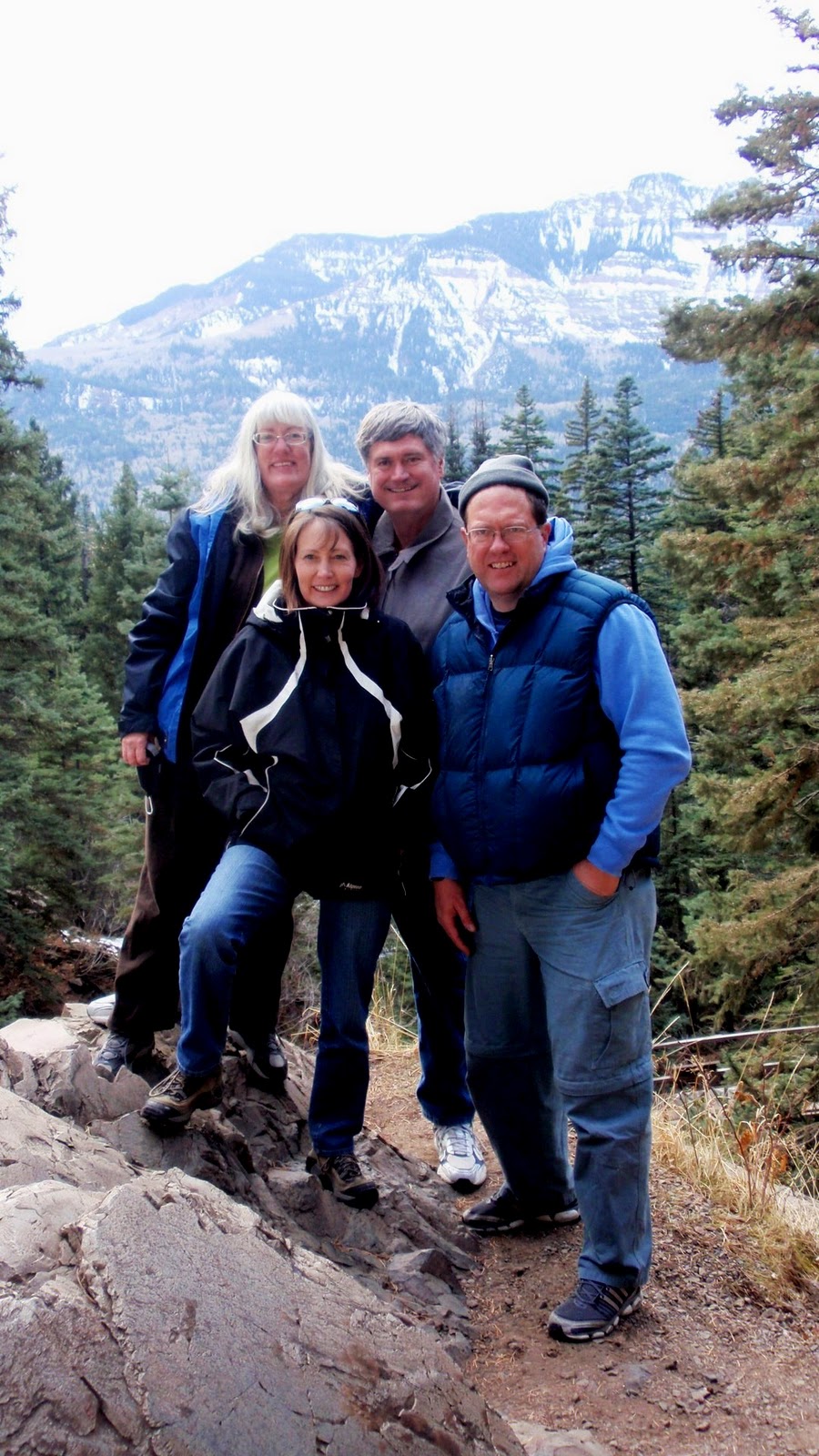
Dorine and I spent the weekend in Colorado with Mike and Judy at the cabin, which of course is a few miles south of Pagosa Springs.  It was a nice, laid-back time and I enjoyed getting out of town for a couple of nights.  The photos above show (a) an outdoor view of the cabin, (b) Mike, Dorine, and Judy in the kitchen/dining area after finishing a 1,000-piece jigsaw puzzle, (c) me at the overlook up the road from Treasure Falls, which is en route to Wolf Creek Pass, and (d) all four of us at Treasure Falls (taken by a family visiting from Texas).