Sunday, June 26, 2011

My Daughter Kiley's Wedding

Sam and Kiley, 6/24/11
My daughter Kiley was married to Sam H____ in the Albuquerque LDS Temple on Friday, June 24, 2011.  Theirs was a whirlwind romance, commencing shortly after (a) Sam arrived home from his church mission to northern Chile last fall, and (b) they met at the LDS Institute of Religion near the University of New Mexico campus in Albuquerque.  (The men in Sam's family traditionally waste no time in getting married after their stints as missionaries.)  Kiley was very young -- 19 in March -- for marriage, but the match is a good one and I have no doubt that Sam will care and provide well for her.  Kiley made a beautiful bride in the custom-designed dress that we engaged Erin M_____ (our bishop's wife) to make for her.  Sam, whose mother Celestine is one-half Japanese, will bring some Asian ancestry into our family, which I think is totally cool.

Do I feel regrets at "losing" our "baby"?  Perhaps a couple.  One, any familial upheaval in my current state of (un)health is more than a little difficult for me to bear.  (I've already sort of latched on to Kiley's dog Mischa -- whom we're now being landed with a second time -- as a surrogate for Kiley.)  And two, I feel wistful that Kiley and Sam have decided she will attend school at the local community college this fall instead of continuing at UNM.  (I can understand their reasoning in light of the extremely stressful -- if ultimately successful in terms of GPA -- freshman year Kiley had as a music major at UNM, which was made much worse by the distractions of becoming engaged and planning a wedding.  However, I still hope she'll go on to earn a four-year university degree, even if she never has to support them or even work full-time.)

[Update: Kiley did ultimately decide to remain at UNM, although she's changed her major to Family Studies.]

Wednesday, June 22, 2011

Looking at the World Through Sh%#-stained Glasses

I find myself sinking further down all the time; my outlook on life is so negative now that I find no cause for optimism or happiness in anything.  I can't help dwelling on the changes of the last two years -- two years ago, I had a sleep disorder and was dependent on prescription sleep meds, true, but I had no crippling illnesses and my job was tolerable.  I had no idea what a simple vacation, followed by a change of manager and new job responsibilities -- and now my having developed a tolerance for heretofore-effective sleep medications -- could do to my life, but the combined effect has been horrible.  None of my loved ones, friends, or acquaintances knows, or can know, what I'm going through.  A recent conversation with one of my brothers made me realize that most people, facing my afflictions and the resulting inability to bear even a moderate amount of physical or emotional stress, simply couldn't function at all; however, it's small comfort that I can still do so at some diminished level of rapacity...er, capacity.

[Update 6/29/11: I received word this week that a former co-worker of mine dropped dead from a massive heart attack last Saturday, the day his family had planned to have a party to celebrate his son's college graduation.  (I'm reminded that my father died on our oldest daughter's wedding day in 1997.)  I wonder if I could be next in line for the same or a similar fate.]

Friday, June 17, 2011

The Mother Road

Aztec Motel - Before Demolition
Aztec Motel - During Demolition


Central Ave. in September 1963
I've always felt a vaguely romantic attachment to Route 66 (John Steinbeck's "Mother Road") and the role it played in the westward migration of Americans from the 1920s on through the 1960s, or when the Interstate highway system came of age.  I've never really understood the evolution of Route 66, although I know that at various stages it had some weird, round-about deviations on its way through New Mexico -- a prime example being that it once went down Isleta Blvd. in the South Valley, and on south to Los Lunas, before it angled northwest and headed toward Grants, Gallup, and the Arizona border.  My father drove bus for Greyhound for some 37 years, and he spent most of that time driving back and forth between Albuquerque and Flagstaff along a very desert-y stretch of Route 66 (and later I-40).  He could say without exaggeration that he knew every bump in the road.  

Before the creation in 1962 of the first freeways in Albuquerque, the primary east-west artery through town was Central Avenue -- US 66 -- along which can still be seen various old motels, storefronts, and even filling stations that date to that era.  Obviously, over time the construction of I-40 sounded the death knell for Central as a stopping-off place for interstate travelers (except for its motel-dotted far-east end, where it intersects with Tramway Blvd. near I-40 -- which intersection is now a prime gathering point for transients with few means and sometimes-running cars); however, even today one can almost feel the presence of ghosts from bygone decades as one drives along East Central.  Most of the old Route 66 motels became fleabags wherein prostitutes often plied their trade, but it's difficult for any long-time resident of Albuquerque not to feel fond of these motels and wish for their preservation.  Thus it was with some sadness that I read recently about the razing of the Aztec Motel, which, in addition to being an old Route 66 motel, had become a landmark for another reason: the plastering on its walls of various bottles, hubcaps, and other neighborhood detritus that lent it an eccentric charm all its own. The two photos above of the Aztec show it prior to its end and as the demolition was commencing.

The third photo is taken from my high school's 1964 yearbook and shows the school's marching band in the State Fair parade in September 1963 (i.e., two-plus months before the JFK assassination).  In the photo, the band is heading west along Central, probably in the vicinity of Louisiana Blvd.  It's fascinating to see what even a small segment of Central looked like in the early 60s!  Note the "US 66" road sign, the old motel and Shamrock gas station in the background, the presence of what must have been (at that time) very stylish late-model cars, and the sign advertising a pizza joint one mile east.  (My mother always took us to see the State Fair parade -- and thus I probably watched this very parade at the age of four -- although we generally parked somewhere near the Fair Plaza shopping center [what we would now call a strip mall] and watched as the parade winded back east along Lomas Blvd.)

The National Park Service has a website on the history of Route 66 that contains various historical photos of sites on New Mexico.  I plan to read all of it soon.

[Update 7/8/11: The NPS website notes that it was in 1937 that Route 66 was significantly shortened, by 100+ miles, as it passed through New Mexico.  Prior to that time, the route took a big "S" through the state, heading northwest from Santa Rosa and coming back through Santa Fe, then passing through Albuquerque in a southerly direction to Los Lunas and then going northwest to the Laguna Pueblo, where it finally turned west again.  (The highway segment that connected Los Lunas and Laguna still exists, although for a long time I thought it to be of recent vintage, presuming it was built to allow judges and other public officials to drive back and forth between Grants and Los Lunas -- which are county seats located in the same judicial district -- without having to go through Albuquerque.  I'm sure that savvy people still use it to bypass Albuquerque, if they're south of town and want to go west, or if they're west of town and want to go south.)  Thus Central Avenue became part of Route 66 in 1937 and then all the motels started springing up.]

Me at Echo Amphitheater, 1963
[Update 1/30/12: Here's a picture of me in almost the exact time-frame in which the "State Fair parade" photo above was taken (when I was four years old).  We were at Echo Amphitheater, located between Abiquiu and Tierra Amarilla in northern New Mexico.  (Inasmuch as my family went to Echo Amphitheater in 1963 at about the same time we went to El Morro National Monument, for years I conflated the two in my mind.  It wasn't until we finally went back to Echo Amphitheater, around 1976, that I was disabused of the notion that Echo Amphitheater had a large, spooky green pool of water -- whereas El Morro, as I knew by then, did have such a pool.)  Ironically, nowadays we pass by Echo Amphitheater every time we go to the cabin (which is near Pagosa Springs, CO), although we haven't bothered to stop there in a number of years.]

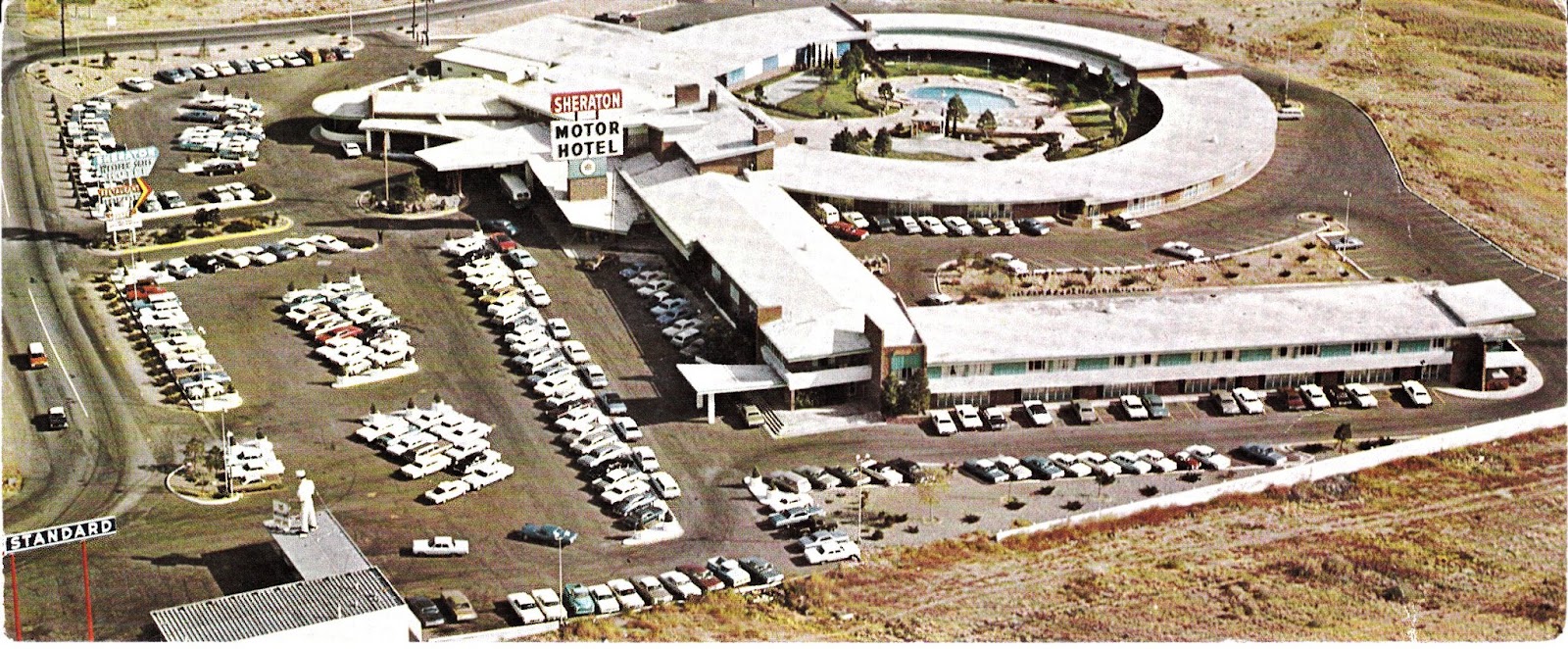
Western Skies Hotel, ca. 1959
[Update 5/26/12: This aerial photo comes from an old postcard I bought on the Internet.  It shows the Western Skies Hotel -- the last (and easily the greatest) of the Route 66 lodges to go up in Albuquerque before the advent of I-40 -- which used to be located at the far eastern end of Central Avenue.  (Route 66 is the divided highway at the bottom right.)  The hotel, which opened in early 1959 according to contemporaneous newspaper articles, was still there when I was in high school; I think it was torn down sometime in the early 1980s.  It once must have been considered the nicest hotel in Albuquerque, as President John F. Kennedy and his wife Jackie stayed there when they came to town in December 1962.  In fact, when I was a senior in high school (in the fall of 1976), I liked a girl in our ward named Peggy C____, who actually lived for a time in the Western Skies presidential suite with her family.  (I remember the door still bore a plaque stating that JFK had stayed there.)

Sheraton Western Skies, ca. 1970
Here's a second view of the Western Skies, circa 1970, by which time Sheraton had bought out the original owners.  (Note the lighter-colored roof and the mascot atop the adjacent Standard station.)  There is now a Smith's grocery store where the Western Skies once was located.]

[Update 6/3/12: Here's a current-day Google Earth view of the eastern end of Central Ave.  The Smith's store -- the former site of the Western Skies -- is the large white-roofed building just right of and below the center of the image.  There is still a gas station across the street, where the Standard station appears in the vintage-1970 photo above.  Note where Central diverges from I-40; the curving road going north, passing under I-40, is Tramway Blvd.]

[Update 10/25/15:  Here is a cool photo of Central Avenue, circa 1970, looking east from Carlisle Blvd.]

Saturday, June 11, 2011

HIke to South Sandia Peak

Our Route - clockwise loop, starting from lower right
I took my "killer" hike yesterday up to South Sandia Peak with Darren and John Brewer.  We started at Canyon Estates (in/near the village of Tijeras, east of Albuquerque), hiking on the South Crest Trail all the way to the upper terminus of the Embudito Trail, then making our way up to South Sandia Peak, and finally hiking down the "CCC Route" to its lower terminus and then back to our starting point.  I wasn't sure how I'd do, but I hung in pretty well; in fact, when the hike was over, it seemed like getting up to South Peak was the easy part, whereas hiking down the extremely steep "CCC Route" took a much-greater toll on me. (Two years ago, John and I hiked up the "CCC Route" on our way to South Peak; I wonder now how I did it, except that my health was better then.)  The only disappointment of the day was arriving at South Sandia Spring and finding it dry; I'd taken along a water filter for the express purpose of having a nice drink of cold spring water, but to no avail.

Anyway, given that I'd wondered if I'd ever see South Peak again, it was especially gratifying to be there and then to hike off the back of the Peak through the cool little canyon and aspen grove there.  I have to say now that South Crest is probably the easiest route to get to South Peak; it's certainly less difficult than any route on the west side of the Sandias.  I can't say what other "long" hikes I'm capable of -- I'm definitely having second thoughts about ever hiking up Chimney Canyon again -- but hiking up and back down the La Luz Trail proper is feasible.

Darren on the South Crest Trail
John in the Aspen Grove East of South Sandia Peak
Darren and I on the South Crest Trail
[Update 6/13/11: I've realized that this map also contains the site of Darren's 2005 Eagle Scout service project -- Carlito Spring, which is just to the southwest of Canyon Estates as the crow flies.]

[Update 6/14/11: I remember that the young men/scouts from our ward spent two nights at Deer Pass, just west from where the Embudito Trail cuts off South Crest, in April 2001 (see the unfortunately fuzzy photo below, taken at South Peak).  Chad Twitchell hiked with the older boys, who were training for their trip to the Philmont Scout Ranch that summer, with full packs all the way from our church building on Indian School Rd. to Deer Pass via Embudo Canyon. (Brutal!)  John Brewer and I took the younger boys (including Darren and John's son Steven) up the Cañoncito Trail on the east side of the range, then south on the Crest Trail, meeting up with the others near Deer Pass.  We had to decide whether to camp on the meadow just south of South Peak or at Deer Pass; ultimately we chose the latter, which turned out to be a wise decision, and for a very simple reason: it put us that much closer to South Sandia Spring, the only source of water in the vicinity.  The spring was still over a mile away, and I can remember having to shuttle down there four or five times for water while we were camped at Deer Pass.  If the spring had been dry then like it was last Friday, we'd have been hurting.  In this photo (taken by Chad Twitchell): Jordan Roper, Steven Brewer, John Brewer, Landon Roper, Rob Pulsipher, Brandon Schofield, David Griffin, me, Brent Phelps, Lance Schofield, Michael Griffin, Curtis Twitchell, Paul Twitchell, and Darren Kartchner.  (Darren and I are the ones with the blue-camouflage boonie hats.)]
Troop 206 at South Sandia Peak, 4/13/01
[Update 6/19/11: Due to the perceived fire hazard caused by the dry conditions this year, the Forest Service has now closed all the hiking trails in the Sandias for the rest of the summer and part of the fall.  I guess it was a good thing we didn't wait to take our South Peak hike.]

Monday, May 30, 2011

Hike to the Head of Whitewash Canyon

The South Foothills of the Sandia Mountains
I took another hike on Sunday, May 29, 2011, this time going by myself and starting at the far eastern end of Menaul Blvd. and taking what the guidebook calls the "Whitewash Trail" (which is sort of a misnomer inasmuch as it neither follows Whitewash [i.e., Piedra Lisa] Canyon nor is much of a trail).  I only intended to go as far as the first little promontory at the head of Whitewash Canyon, and I was able to ascend that high, although the weather was hot and the steepness of the route -- it gains 2,000' in elevation in two miles' horizontal distance -- had me huffing and puffing most of the way.  (The route passes through the site of a brush fire that happened a couple of months ago, which was reportedly caused by people lighting fireworks.)  The saving factor for me was the 25-30 mph wind that was blowing, which kept me pretty cool.  The map above shows both the route I took this week and the hike that Darren and I did last week to the "Eye of the Sandias."  (My next Sunday-afternoon hike will probably take me up Embudo Canyon, located in between my last two routes.)

Looking North
Looking South


[Update 6/6/11: I took a hike up Embudo Canyon yesterday afternoon. I started at the open space parking lot at the end of Indian School Rd. and hiked up past what I call "the narrows" into the wider eastern end of the canyon, turning around at the start of the rocky switchbacks that lead to the junction with the Three Gun Spring Trail. It was a pretty easy hike compared with the last two that I did, but "two miles up and two miles back" seems to be a pretty good length for a Sunday-afternoon hike.  I'll probably start moving north for additional hikes. Note that I have modified the attached illustration to add the Embudo Canyon route that I took yesterday.]

Sunday, May 22, 2011

Hike with Darren to the "Eye of the Sandias"


I've been telling my therapist (in the employee assistance program at work) for several weeks that I would start taking short hikes on Sunday afternoons, after church, just to be able to do something "healing" for myself every week.  (We'd discussed at length what I could do as a "restorative" measure, and hiking was about the only thing I could do regularly that wouldn't cost a lot of money.)  Unfortunately, I've found that it's much easier to stay on the couch than to get off it, particularly on Sundays -- and especially with the fatigue that my chronic dizziness causes -- so the psychologist, the internist, and the sleep tech had to gang up on me last week to shame me into going hiking, finally.  I'd picked out the first hike I wanted to do, which was to hike up to the "Eye of the Sandias," a "quirky landmark" mentioned in Mike Coltrin's Sandia Mountain Hiking Guide.  My brother-in-law Mike and I tried to find the "Eye" sometime back, but we got lost and finally turned around.  (We also weren't prepared for the difficulty of the hike -- the route is only two miles one-way, but it's very steep and loose in places.)  Anyway, Darren and I went and did the hike today (it's a good thing Darren went, as I would have become lost again otherwise); I had to stop a lot to catch my breath, but, really, I did surprisingly well, all things considered.  So well, in fact, that I think I can manage the next "killer" hike I'd like to do, which is to hike up the South Crest Trail to South Sandia Peak and then back down the "CCC" Route. The attached photos show me and Darren with the "Eye," which supposedly is a comment, first painted in the 1960s (and touched-up in 2002), on the encroachment of society on the Sandia Mountains.  (The Zia symbol in the "pupil" suggests a Native American origin or influence.)

[Update 10/24/11: I hiked up to the "Eye" again yesterday afternoon, this time by myself.  It was much easier to find the second time, although I'd already forgotten how long the hike was.]
Me and the "Eye"
View of I-40 from the "Eye"

Wednesday, May 18, 2011

Life Must Have Meaning

The other day I was reading about how Stephen Hawking, the eminent British physicist, referred to the concept of Heaven as a "fairy story."  One could understand why a scientist who has lived for so long with profound physical disabilities questions the existence of God and the notion of life after death.  What I question, however, is Hawking's follow-up statement to the effect that human beings should fulfill their potential by making good use of their lives.  To what end?  If life has no purpose, and no meaning independent of the here and now, who's to determine what any of us "should" do?  Indeed, it is my experience that people who don't believe in life after death generally become increasingly self-absorbed, heedless of the consequences of their actions to others, and much less likely to exhibit true charity.  They tend not to take on the responsibilities of marriage and parenthood -- they profess concern about the state of the world that the current population will leave to succeeding generations, but it's apparent to me that they don't really care about the future beyond their own demise.  As long as they get theirs in their lifetimes -- they seem to think -- and leave no progeny, why should they care about the prospect of economic/societal collapse and the civilized world's being sacked by the barbarians at the gates (or, worse, by the ones in our midst)?  The fact that these people see wispy bogeymen like "climate change" as bigger existential threats than the bankrupting of the federal treasury, or the possibility of some terror group's obtaining and detonating a nuclear weapon, speaks volumes about how basically whacked they are.

On the other hand, it's a little ironic that I write about life's needing to have purpose, given how little meaning I feel my life has at this paraje.  The truth is that my family members -- wife, kids, grandkids, mother -- are my life's purpose, and I bear significant burdens for them that aren't always apparent.  (Heck, just living with my mal de debarquement dizziness is sometimes more burden than I think I can tolerate.)  The reward is that occasionally I get to spend time with my loved ones in beautiful places, such as last weekend at "our" cabin in Colorado -- see the photo above of my grandson Mason on the road outside the cabin, taken on Saturday, May 14.

Sunday, May 8, 2011

My Colonoscopy

I had my "screening" colonoscopy on Friday, April 29; the immediate result of the procedure was that the doctor found two polyps on the "splenic flexure" (see attached photo), which he removed and sent to the lab for biopsy.  As I write this, I have yet to receive the pathology report, but, assuming neither polyp was pre-cancerous, I won't have to undergo another colonoscopy for ten years, assuming I live that long.

The worst part of the procedure, by far, was the "prep," which entailed certain dietary restrictions and mega-doses of laxatives.  During the last 24 hours before the colonoscopy (which, because my procedure was in the late morning, actually worked out to ~34 hours), I was restricted to a "clear liquid" diet, which in my case meant beef bouillon, chicken bouillon, popsicles (no red or purple), and (blue) Gatorade.  I had to take four Dulcolax tablets at noon on Thursday, which started the "flood," and then, after dinner, I had to drink 64 oz. of Gatorade mixed with 8.3 oz. of Miralax -- fourteen standard doses.  (The instructions called for me to drink 8 oz. of the Gatorade/Miralax mixture every fifteen minutes, but I actually drank it 12 oz. at a time and thus had it all down in 75 minutes.)  Needless to say, I spent a lot of time that evening on the john, although at least I didn't feel much abdominal discomfort.  I couldn't force myself not to take my sleep meds that night, which made me concerned about how they might "cloud" things the next day; however, the report said the quality of my bowel preparation was "good."

I'm told that a colonoscopy only qualifies as a "preventative" medical procedure, in insurance terms, if it doesn't turn up any polyps; therefore, I'm now expecting to have to pay for a sizeable share of it.  And now we've eliminated one more thing -- colorectal cancer -- as a contributing cause of my post-cruise dizziness; I only hope the pathology report comes back "clean" so that I don't have to go through this again in five years (again, assuming I live that long). 

[Update 5/13/11: The pathology report came back -- the two polyps were "adenomatous," meaning they had the potential to turn cancerous, but that there was no actual cancer.  I guess that puts me on the "five year" track for having another colonoscopy.  Crud!]

Thursday, May 5, 2011

On Turning 52

Today I turn 52 years old (going on 95).  I think I'm rapidly becoming the Ebenezer Scrooge of birthdays (Bah! Humbug!), inasmuch I don't regard my own birthdays as cause for anything but to be more depressed than I already am.  The attached fuzzy photo is one that I had Dorine take of me (with my cellphone, at the gym) to mark this occasion.  I can't help contrasting what I look like from behind now with how I looked just a couple of years ago.  The 20-25 lbs. I've put on in the interim -- most of which I gained shortly after our "fateful trip" to the Caribbean in January 2010 -- went right to my midsection and has left me looking every bit as old as I feel.  (I guess my legs still look like those of a younger man -- check out the definition in those calves! -- but then they benefit directly from all the "cardio" exercise I do.)

I also can't help noticing how my blog posts have tailed off -- 121 in 2008, 66 in 2009, 47 in 2010, and only 9 or 10 so far this year.  I think I've said most of what I had to say, and, feeling as chronically bad as I do, I don't have much energy or will to think of things to write, much less actually to write them.

Saturday, April 23, 2011

How Is the Air Up There?

The La De Das
I've made reference a number of times on this blog to my taste for what some have referred to as "mid-60s garage punk."  In recent months I've come to like a song called "How Is the Air Up There?" which really exemplifies the genre.  It was first released in early 1966 by an American group called The Changin' Times, and then covered by a New Zealand band named The La De Das, which "cover" I regard as the definitive version.  I became aware of the tune after I acquired a collection called Nuggets II: Original Artyfacts from the British Empire and Beyond; it immediately struck me as the very sort of dance tune I would have loved in my punk/New Wave days in the early 1980s.  Not surprisingly, I've since discovered that The Bangles, who started out as a sort of proto-punk band, included a version of "How Is the Air Up There?" on the five-song EP they released in 1982; they mined quite a bit of 1960s material in their early releases, in the process revealing fine-edged pop sensibilities.  (The La De Das moved their act to Australia and stayed together until the mid-1970s, although their later material -- some of which can also be heard on Youtube -- seems to have been rather unremarkable.)

Saturday, April 9, 2011

Updates

1. I think it's funny how Donald Trump has gone around publicizing the so-called "birther" notion that Barack Obama is not a "natural born citizen" of the United States and is therefore ineligible for the office of president of the country.  I regard it as a moot point -- no matter what came to light at this late juncture, no federal court in the country would purport to disqualify Obama from the office he's occupied for the last two-plus years.  (And I learned long ago that the Constitution says or means no more, and no less, than the U.S. Supreme Court says it does.)  What is annoying to me, however, is that any Republican presidential candidate whose citizenship status was the least bit in question would have been hammered about it in the media long before he was elected president.  The double standard is both obvious and ominous.  (As regards Obama, I'd much rather see his SAT and LSAT scores, together with his transcripts from Occidental College, Columbia University and Harvard Law School, than his long-form "certificate of live birth."  I, like millions of others, would like to see if his academic record truly reflects his putatively prodigious intellect, or if his various schools gave him a pass -- his serving as editor/president of the Harvard Law Review without authoring so much as a case note, much less an in-depth law-review article, being one strong indication that such was the case -- much like the media did during the 2008 election campaign.  If any of the aforementioned documents is ever released publicly, I'll be amazed.)

2. Dorine and I have lived in our home now for twenty years, and we recently paid off our first mortgage (which we'd re-financed twice in the interim due to falling interest rates).  It took only twenty years to pay off our house because of one reason -- from the time we moved in, we paid $100 in "extra principal" every month on our mortgage payment.  It's astounding, looking back, that that one thing lopped off ten years of payments -- without adjusting for the time value of money, we paid $24,000 to save roughly $80,000 -- but such is the power that accruing interest holds, either for good or for ill.

3. Dorine and I have started working at the temple as ordinance workers -- again, in my case -- on the even-numbered Wednesday evenings.  I don't feel any better from the afflictions that caused me to ask to be released from the temple last October, but working only two shifts per month now is much more manageable for me than was working every week.

4. For all the diagnostics that have been performed on me since I fell ill following our Caribbean cruise in January 2010, nothing definite has been found to be wrong with me.  Recent blood work showed my liver enzymes to be sharply elevated, which would normally indicate hepatitis of some kind; indeed, I was having gastrointestinal issues of the same sort I had in 1980 when I was diagnosed with Hepatitis 'A' while serving my mission in Chile.  However, a hepatitis screen came back negative for all varieties of hepatitis, and just yesterday I had blood drawn for another hepatic function test.  If my enzyme levels are still high, I'm probably looking at having an ultrasound done of my liver; in addition, I'm having a "routine" colonoscopy done at the latter part of this month.  It will be interesting to see if either of those procedures shows anything seriously amiss.  I've also wondered if I could have some kind of persistent parasite that I picked up in the islands -- except that most parasites cause people to lose weight, whereas I've actually put on 20-25 extra pounds since the cruise.  I still ponder what could be causing my health issues, but I've come to the point where I can no longer distinguish cause from effect.  Two years ago, my sleep disorder was still my chief complaint; if only that were still my biggest health problem!

5. My nephew Aaron P_______ has now come home from his mission to Russia, and he'll shortly be going back to school at BYU-Idaho.  Hopefully, he'll have a chance to see Darren -- who, for the time being, is still in Provo -- on the way to Idaho.  The two have not seen each other in over three-and-a-half years now.  Darren will be working here this summer at Sandia National Laboratories, and I look forward to having him here for an entire summer for the first time since 2007.

Sunday, March 27, 2011

KCGL - "Modern Music" Radio Station
in SLC (1983-86)


I was thinking the other day about KCGL, an FM radio station in Salt Lake City that was a cutting-edge "modern music" station circa 1983.  (I vaguely remember the call letters "KABE" and thus believe that KCGL may have been preceded by KABE as the "alternative" station in the area; however, for present purposes I'll lump them together.)  I first became aware of KCGL when I went and spent a few days in August 1983 with my friend Bob Maes and his parents and siblings in Sandy, UT.*  Bob was always more informed than I about popular music, and he had me start listening to KCGL while I was there.  The station was a revelation, as I'd never before heard such interesting music, and from such obscure artists, on commercial airwaves -- and it seemed to be a going concern and very popular with young people on the Wasatch Front.  To give some context to this phenomenon, I try to imagine a radio station today, virtually anywhere, playing nothing but the newest, hippest indie-rock music; it just couldn't be, because any business-feasibility study would predict failure due to lack of advertising revenues.

Anyway, for the next couple of years Bob periodically recorded bunches of songs off KCGL and sent them to me on cassette tapes, and I was always grateful to get them.  Ultimately, however, KCGL did fail; I'm not sure when or precisely why -- although the rise of hip-hop and grunge-rock, together with the growing popularity of "classic rock" formats, probably contributed to its demise.  (I'm not sure how it maintained a core of advertising clients as long as it did, when its ever-changing playlist was so far out front of the usual crap one heard on the radio.)  It's common to look back now on the 80s and laugh about what was popular then -- I chuckle when I remember how Bob's younger sister Monica and her friends wore men's pajama bottoms, with the flies sewn shut and the legs tucked inside stockings, in lieu of pants -- but some of the "modern music" from that era is still very interesting.

The foregoing Youtube embeds contain songs that I like even now, all of which I first heard on KCGL during that stay with Bob and his folks in 1983: (1) "The Animal Song" by the Europeans; (2) "All Lined Up" by Shriekback; (3) "(If You Ask Me) I Won't Say No" by Pete Shelley; and (4) "Guitar, Talk, Love and Drums" by Gary Myrick and the Figures.  I like the two live performances (which thankfully sound very different from the studio versions of the songs) a lot better than the two execrable music videos -- the latter "art" form being one of the truly lamentable fixtures of the 80s music scene -- but it's all good.

* Bob grew up in Albuquerque and, though we hadn't known each other previously -- having grown up on opposite sides of town and in different stakes -- we roomed together as freshmen at BYU in the 1977-78 school year, and, later, for an additional semester in 1981 after our missions. Bob left on his mission to Argentina in December 1978 from the Albuquerque 5th Ward (which at that time took in the entire North Valley and the West Side north of I-40, an area that now encompasses 2+ stakes by itself); however, shortly thereafter his father took the job of postmaster of Sandy, and thus Bob went "home" from his mission to Utah.

[Update 3/31/11: It appears from information available on the Internet that KCGL passed from existence as a New Wave station, and adopted a "Christian rock" format, sometime in 1986.  (Apparently another SLC-area station, KJQN, then picked up the "alternative music" gauntlet for a few years, but that's beyond the scope of my experience.)  I'm sure it was a decision primarily driven by finances, but it's difficult to say which was more incongruous with being located in the demographic/political center of the Mormon Church (KCGL's broadcast facility was apparently located in Bountiful/Centerville to the north) -- a gritty "modern music" radio station or a schmaltzy "Christian rock" radio station.]

Sunday, March 20, 2011

Random Thoughts, Part 6

1. I've become convinced that the federal government's energy policy -- to the extent it has a coherent policy -- has as its sole purpose to drive up energy prices and inflict pain on the citizenry.  Given that our government is supposed to be "for the people," that's a remarkable conclusion to draw.  We're seeing unabated assaults on the internal combustion engine, which is still the key to affordable private-vehicle ownership.  And the greatest freedom an American citizen has is the ability to get in his car and go anywhere his time and resources allow.  However, the Obama administration's stated goal, which cannot be for the purpose of increasing mobility or driving down transportation costs, is to create access -- unprofitable, costly access -- to high-speed rail for 80% of the population.  I regard it as fair to infer from that goal that the government means to restrict mobility by limiting transportation options, essentially so that it can ultimately tell most of us where we can go and when.  The interstate highway system, which greatly increased mobility and drastically reduced the costs of transporting freight by truck, is generally viewed as one of the crowning achievements of the Dwight Eisenhower administration (1953-1961); however, I suspect strongly that if these highways didn't already exist, the Democrats would do all they could now to prevent their being constructed, favoring localized rail lines instead.  Recall this exchange between Sam Neill and Sean Connery, playing Soviet naval officers in the film The Hunt for Red October (1990) and discussing what it will be like to live in America after defecting:
Borodin [Neill]:  [A]nd I will have a pickup truck, or possibly even a...recreational vehicle...and drive from state to state. Do they let you do that?
Ramius [Connery]:  Yes.
Borodin [Neill]:  No papers?
Ramius [Connery]:  No papers. State to state.
I reiterate: Mobility, and the liberty it represents, is a hallmark of an even moderately free society.  High fuel costs, which are largely a function of supply, or rather perceived supply -- which in turn is affected by Middle-East unrest, curtailed domestic drilling, vindictive and politically opportunistic litigation, and overblown (even trumped-up) environmental concerns -- have already begun to erode that freedom in the United States. The government is way too involved in it all for me to believe it isn't by design.

2. I recently watched most of ESPN Films' "30 for 30" documentary The Fab Five, which I found fascinating.  I've always regarded the "Fab Five" phenomenon -- which resulted from the University of Michigan's 1991 signing of what is widely considered the greatest men's collegiate basketball recruiting class ever, consisting of Chris Webber, Juwan Howard, Jalen Rose, Jimmy King, and Ray Jackson -- as having triggered an acceleration in the coarsening of American culture.  Yes, Michigan was a good team, reaching the national championship game in the "Fab Five's" freshman and sophomore years (although investigations into NCAA rules violations later caused the university to forfeit games and vacate tournament results from those years).  However, the fallout from their smack-talkin', baggy short-wearin', tattoo-barin', arrogance-laden influence -- which seemingly has made it impossible for most basketball teams, regardless of the level of competition, to compete with sportsmanship, lose with class, or win with grace -- has been something of a national debacle.  Jalen Rose, currently an ESPN commentator, sparked controversy recently by stating that, at least when he was young, he regarded African American players who signed with Duke University to be "Uncle Toms," or traitors to their race.  The reason?  Simply, that Duke wouldn't recruit him or other black players from the 'hood.  It took a white ESPN Radio commentator to point out what should have been obvious to Rose -- and to all the African Americans who seemed to use the "Fab Five" in their college heyday as surrogates for sticking it in "White America's" face -- namely, that it was always more an issue of social class (never mind academics) than one of race, and that negative responses to the "Fab Five's" antics (probably even the most blatantly racist examples) were more in reaction to a perceived lack of class than to the players' blackness per se.  (I remember cheering when North Carolina won the 1993 national championship game, which it did in large part because Chris Webber called a timeout with seconds left in the game -- when Michigan didn't have any timeouts left -- which in turn resulted in a technical foul and a change of possession.  On the other hand, I was supremely disappointed when the heavily favored [and mostly black] UNLV lost to Duke in the 1991 Final Four.)  The overweening tendency of some people to see a racist behind every rock says much more about their skewed point of view than about their environment.  In any case, I'm no Duke fan, either, but I'd say that time has vindicated coach Mike Krzyzewski's recruiting strategies: the Michigan program has only barely started to recover from what the "Fab Five" did to it, whereas Duke has won multiple NCAA championships in the intervening years. 

[Update 3/21/11: Michigan nearly caused me to have to eat my words yesterday when it almost beat Duke in this year's NCAA tournament; I definitely sensed some added motivation on Michigan's part, related to the timing of the release of The Fab Five, to pull off the upset.]

[Update 3/24/11: I feel like I must add, in fairness, that men's volleyball -- traditionally played in the United States by more-affluent Caucasians -- has always been full of trash-talking and arrogance.  In fact, male volleyball players are significantly more sportsmanlike now than they were in 1978, when my brother Robin took me to El Paso, TX to watch the USVBA national tournament; during the course of that weekend long ago, I saw more on-the-court yapping (even between teammates) than I had seen in my entire life to that point.  Of course, it's a lot "safer" to mouth off to an opponent across a net than in closer quarters; those rich white guys would have been missing some teeth had they acted that way on a basketball court in those days.  However, in a larger sense I think it serves to illustrate why animosity to the "Fab Five" was primarily based on notions of class rather than race. I mean, how much difference is there, really, between wealthy Caucasians behaving badly because they think they're better than everyone else, and poor African Americans behaving badly to compensate for being told they're not as good as everyone else?  It's the bad behavior that middle-class white Americans tend to find obnoxious, not the skin color.]

3. I've been re-reading Fleetwood: My Life and Adventures in Fleetwood Mac, the autobiography of drummer Mick Fleetwood that was first published in 1992.  In retrospect, the most remarkable thing about the Fleetwood Mac story was the band's navel-gazing and unspeakable self-indulgence in its glory days of 1976-1982.  The popular-music scene is so different now that one can say with confidence that no rock band will ever reach those depths again; and that fact, combined with the vibrancy and creativity of today's indie-rock sector, tells me the changes have generally been for the better.  Today, it would require only three or four weeks, and a mere few thousand dollars, to record an album of comparable quality to Fleetwood Mac's 1977 album Rumours, which took an obscene eighteen months, and untold millions of dollars, to produce back in the day.  The fact that today's technology enables almost any band to produce high-quality recordings -- in turn rendering expensive recording studios, and all-powerful record companies, virtually obsolete -- constitutes cosmic justice in my mind.  I'm sure that dinosaur bands like Fleetwood Mac can still make a decent living on the "classic rock" concert circuit, but the days of their cocaine-fueled studio excesses are long gone.  Good riddance, I say.

4. I've been experimenting recently with growing the nails out on my right hand for playing the guitar.  It's amazing how much easier finger-picking is when you have fingernails with which to "grab" the strings.  Inasmuch as I mostly play electric guitar nowadays, I generally play with a flat pick, held between my thumb and index finger; however, at the same time I do a lot of upstroked finger-picking with my middle, ring, and little fingers, and the nails definitely help me get a consistent "attack" and tone out of the strings.  The drawback is that having long fingernails is about like having facial hair: it drives me crazy!

5. On Monday, March 14, Kiley, Dorine and I ate lunch at the JB's restaurant adjacent to the Plaza Inn on South Temple Street in downtown Salt Lake City.  It dawned on me as we ate there that the Plaza Inn, then a Howard Johnson's hotel, was where Dorine and I spent our wedding night (and several more nights, which cumulatively made up our "honeymoon").  It was strange to contemplate the passage of 26+ years since our wedding day, which could almost have happened yesterday.  It was even more strange to realize that when Kiley is married this summer, and then when Darren goes back to school in the fall, Dorine and I will be living on our own for the very first time in our marriage.

5. I was reminded recently of Sweetwater Rescue, a documentary of the misadventure of the Willie and Martin handcart companies of 1856 (and the heroic rescue effort that was mobilized to save the survivors), which documentary was written by Heidi Swinton and then filmed by Lee Groberg in 2006.  (I own the DVD, having bought it for a Sunday School lesson a couple of years ago.)  It's a very informative, well-done film that tells the story of the handcart companies -- and the extremities they endured -- from a fairly objective point of view.  That is, the text and commentary are objective -- I defy anyone with even a dollop of heart and human compassion, however, not to be moved by the combination of the written text, the commentary, the visual images, and, especially, the music.  I fell in love with one very plaintive, mournful theme for harp and recorder that provides the audio backdrop for the Martin Company's crossing of the Sweetwater River at Devil's Gate, Wyoming, as depicted in the following segment embedded from Youtube; in fact, I literally cannot listen to it without weeping.  The music director for the film, Sam Cardon, is a nephew of my Aunt Helen S______ (who died in 2004); Cardon really surpassed himself with this project, although I haven't been able to ascertain whether he composed, or merely arranged, the theme mentioned above.  (By the way, he and I aren't related, although we have a set of first cousins in common.)
Friday, March 18, 2011

So Tired

I really haven't felt like writing much lately, despite all the thoughts I've had about the world.  I've suffered something of a relapse concerning my mal de debarquement dizziness; I hadn't realized just how much better I'd been feeling until I started feeling lousy again.  There seem to be two causes: one, I haven't been sleeping well lately due to having developed a tolerance for both prescription sleep meds (Temazepam and Zolpidem/Ambien) that I was using; and, two, I've been feeling a heightened level of work-related stress.  Given that sleep is the one palliative that I know I can count on, and that stress aggravates my condition like nothing else, it's been a double whammy of bad.  I've been using a different "PAP" machine since November -- our insurance company regarded the Resmed "VPAP Adapt SV" as a "lifetime" rental (meaning that it would never simply buy the machine for me); the local medical supply company was still collecting a monthly co-payment from me (which would have gone up sharply in 2011); and my brother Jeff very generously gave me a Resmed "VPAP Auto" machine to use.  The "VPAP Auto" doesn't provide the same sophisticated relief from sleep apnea as the "VPAP Adapt SV" -- moving from one to the other was somewhat like going from a Lamborghini to a Toyota in terms of high-end performance -- but it has all the functionality I need, and it's saving us a ton of money!

Dorine, Kiley, and I went to Utah last Friday evening, spending five nights in Provo and getting to see lots of family and friends, including Darren, all four of my brothers, Dorine's brother Brian and his family, and Bob Maes, my old BYU roommate.  We stayed in the Provo Super 8 hotel, which is (a) kitty-corner from the BYU football stadium on Canyon Road and University Parkway, and (b) less than half a mile from Darren's apartment at Stadium Terrace.  Kiley went along partly to look at bridal gowns at a couple of shops, as -- oh, have I not mentioned it before? -- she is engaged to be married on June 24 to Sam H____, a recently returned missionary whom she met here in Albuquerque.  Kiley only turned nineteen earlier this month, and she seems very young to be thinking about marriage, but Sam is a good match for her: he loves her, and he's got both goals and the drive/wherewithal to achieve them.  I drove all the way up to Utah and all the way back, taking what is now my least-unfavorite route, bypassing Bloomfield, (most of) Farmington, Kirtland, Shiprock, and Cortez.  (If only I could find a way to bypass Monticello, Moab, Wellington, and Spanish Fork, too!)

We intentionally came home in time for birthdays -- Devery's, Maddison and Hailee's (see attached photo), and Nicole's.  And now I've been absorbed in the NCAA men's basketball tournament; I'd like to see BYU go deep in the tournament, and they've won their first-round game, but they are hampered by not having a credible inside-outside game (ever since the dismissal of Brandon Davies from the team for an unspecified honor-code violation) that would otherwise lead to open three-point shots for their star player Jimmer Fredette.  Oh well, so long as teams from the Big East Conference (which I regard as highly overrated) continue to lose; I'm no big Duke or Kansas fan, but I'd much rather see either of them win than Connecticut, Syracuse, Cincinnati, Notre Dame, or West Virginia.

[Update 4/18/11: Of course, Connecticut won the national championship, which is a bummer despite the fact that 9 of the 11 Big East teams lost in the first two rounds.  BYU managed to make it past the first two rounds and then took Florida to overtime in the "Sweet 16" -- which is pretty remarkable given that Jimmer Fredette had to create almost all of his shots off the dribble, mostly against taller, quicker people.  The usual naysayers are pooh-poohing Fredette's NBA prospects, but he's a good enough shooter to do some real damage on a pro team that can consistently get him open, squared-up jump shots.]

Sunday, March 6, 2011

The 11th Ward - The Past Comes Alive

Ward Campout, August 1981 (near Cuba, NM)
Joe Regulator and the Little Factories, August 1981
Doing the "Time Warp"
Ken Mantlo singing "Planet Claire"; Tracy Carroll on bass
Me playing guitar with Morris Carrillo, Patty McGraw on the right
Danielle Aleman singing "Wedding Bell Blues," April 1983
Out with the girls, ca. 1982
Dancing with Tommy Gallegos
Man, I love the Internet!  Mark Alford, a fellow I knew in the old Albuquerque 11th [singles] Ward, started a Facebook group for 11th Ward alumni.  Quite a few of the "members" are people I didn't know -- or at least not well -- inasmuch as the ward started several years before I got there and lasted several more years after I left. However, once people started scanning and uploading old photos they had from 11th Ward activities in the early 1980s, miracles happened.  Events that I thought were lost to the tides of time -- see my posts from a couple of years ago about the 11th Ward -- washed back ashore through photos that I didn't know existed.  The Facebook group formed for purposes of a reunion dinner, to take place at the Quarters restaurant (on Wyoming Blvd.) here in town this Saturday.  I won't be around to attend the reunion, but the pictures I've posted above are a gift that I couldn't have anticipated.

The top photo is from the ward campout in August 1981, which was at a campground in the forest east of Cuba, NM.  (I'm standing right of center in the overalls and the blue-white-and-red sweater.)  The second, third, and fourth photos are from the ward "gong" show that same summer and document the one-and-only public performance of Joe Regulator and the Little Factories, the "punk" group that my buddies and I formed.  (I'm in white, playing my old Gibson SG; Ken Mantlo is in the tux and is playing my old National Telecaster copy; Tracy Carroll is playing bass and wearing the red "pig" mask [and his dad's "throw-up" sport coat]; Greg Acton is playing drums; Dickerson Watkins and Chuck Stewart are singing in a couple of the shots; and Morris Carrillo played piano/guitar.)  It's seems odd that, at the time, the Boyd K. Packer reference was pretty obscure -- if perfectly suited to our purposes! -- and no one seemed to think much of it; however, whenever I mention it to someone now, they usually act like I'm guilty of blasphemy.  (Personally, I think the comparison of a pubescent boy's private parts to a "little factory" -- one that must be guarded against "overproduction" -- is one of the worst metaphors in the history of the English language and thus merits ridicule.)

The fifth photo shows Morris Carrillo and me playing guitars at an activity -- probably not the ward campout -- in the summer of 1981.  The sixth photo shows Danielle Aleman (and backup singers Doug Porter, Joyce Hodshire, and Pam Aguilar) performing "Wedding Bell Blues" at the Haines Street chapel for her long-time boyfriend Jeff Jolley.  (Lee Ann Morrell played piano -- and I the guitar -- off camera to the right.)  The sixth photo shows the group of us guys who dressed in drag, probably in the summer of 1982, for a "nerd" dance at the Institute building near the UNM campus.  (Left to right: me, Ron Wiser [now the president of the Roswell, NM stake!], Bob Lenberg, Dickerson Watkins, and Tracy Carroll.)  I remember that we all rode down to the dance in the same car; I kept thinking, "Man, I hope we don't get pulled over!"  The last photo, obviously from the same event, shows me dancing with Tommy Gallegos, one-time BYU yell leader; judging from my expression -- which, by the way, was affected for the camera -- I was having fun!

Looking back from the perspective of going on thirty years, I marvel at what good times those were.  If only I hadn't been such a self-absorbed jerk....

[Update 3/17/11: I've found the experience of posting messages on Facebook to other 11th Ward alumni to be interesting and somewhat dismaying.  I think it came down to this: one, when it comes to writing, I'm significantly more prolific -- loquacious, even -- than almost everyone I know; and, two, despite the fact that I didn't start the FB group or seek out people to add to it, I felt a greater draw to the group, and to our common past as members of the singles ward, than did almost everyone else.  I think more than a few people interpreted my comments and attempts to spark discussions on FB as (a) self-centered efforts to draw attention to myself, and (b) being indicative of an unseemly tendency on my part to live in the past (which in turn might suggest dissatisfaction with the present).  In addition, I'm apparently not much less irreverent than I was thirty years ago, whereas some of my erstwhile friends obviously regard themselves as changed, totally ignoring the fact that they were once even more irreverent than I.  Well, I can't deny that I'm more self-focused than is healthy, or that I have a few regrets about both my past and how my life has turned out, or that my sense of humor is still pretty crude; however, the truth remains that most 11th Warders were, and are, pretty guarded and superficial about their feelings -- not to mention the fact that some also lack self-awareness and have become unbearable scolds -- despite their professed affinity for each other.  As has generally always been the case concerning other church members and me, I have noticeably more affinity for them than they do for me. Maybe it was always thus; in any case, I now face the world a little wiser.]

[Update 7/26/11: Mark Alford posted the group shot of 11th Ward members that I've inserted below, which is difficult to date precisely, although there are a few clues.  One, Sue A______ appears in the photo; I'm pretty sure she didn't return from her church mission until the early part of summer 1982, so the photo couldn't have been taken before then.  Two, Phill Auth (who left on a church mission in January 1983) and Jacque Gallion (who married Jeff Rasmussen, and thus left the ward, also in January 1983) likewise are in the photo; therefore, it couldn't have been taken later than December 1982.  Three, the overcoats, dead grass, and what appears to be snow in the mountains in the background fix the time of year as most likely being from November to March.  Putting all this together suggests that the photo was taken sometime in November-December 1982, although I naturally wonder where Tracy Carroll, Ken Mantlo, and I were, not to be included in this group.  At any rate, it's a great picture and includes many of the people whom I regarded as the "core" of the ward (from left to right, more or less): Pam Aguilar, Jeff Jolley, Jeanelle Carlisle, Sue A_____, Bill Carr, Joyce Hodshire, Craig Mortensen, Kathy Katzenberger, Owen Laurion, Erick Brown, Ron Wiser, Carol Jones, Dan Raney, Dickerson Watkins, Phill Auth, Bart Norton, Jacque Gallion, Bob Lenberg, Kathleen Raney, Doug Wallace, Bob Henson, Charlene Alderson, Tommy Gallegos, Cheri Owens, Cathie Thomas, and Jamie Thomas (Cathie's adopted son).]
Albuquerque 11th Ward members, ca. late 1982
[Update 11/25/11: Here are two photos, taken by me on 4/1/11, of the old 11th Ward meetinghouse, which started life as the LDS seminary building for the Albuquerque Indian School (AIS).  I'm not sure when AIS ceased operations, but the seminary building apparently stopped functioning, as such, some years before the school itself closed.  Obviously the church then made other use of it for some years -- it was well-suited to the singles ward (apart from the rather "ghetto" location) -- before selling it.  It currently has no occupant and looks pretty run-down.]
Old 11th Ward Meetinghouse, Apr. 2011
9th St. and Cutler Ave. NW
Shawna M, ca. 1984
Sue A, ca. 1980