 |
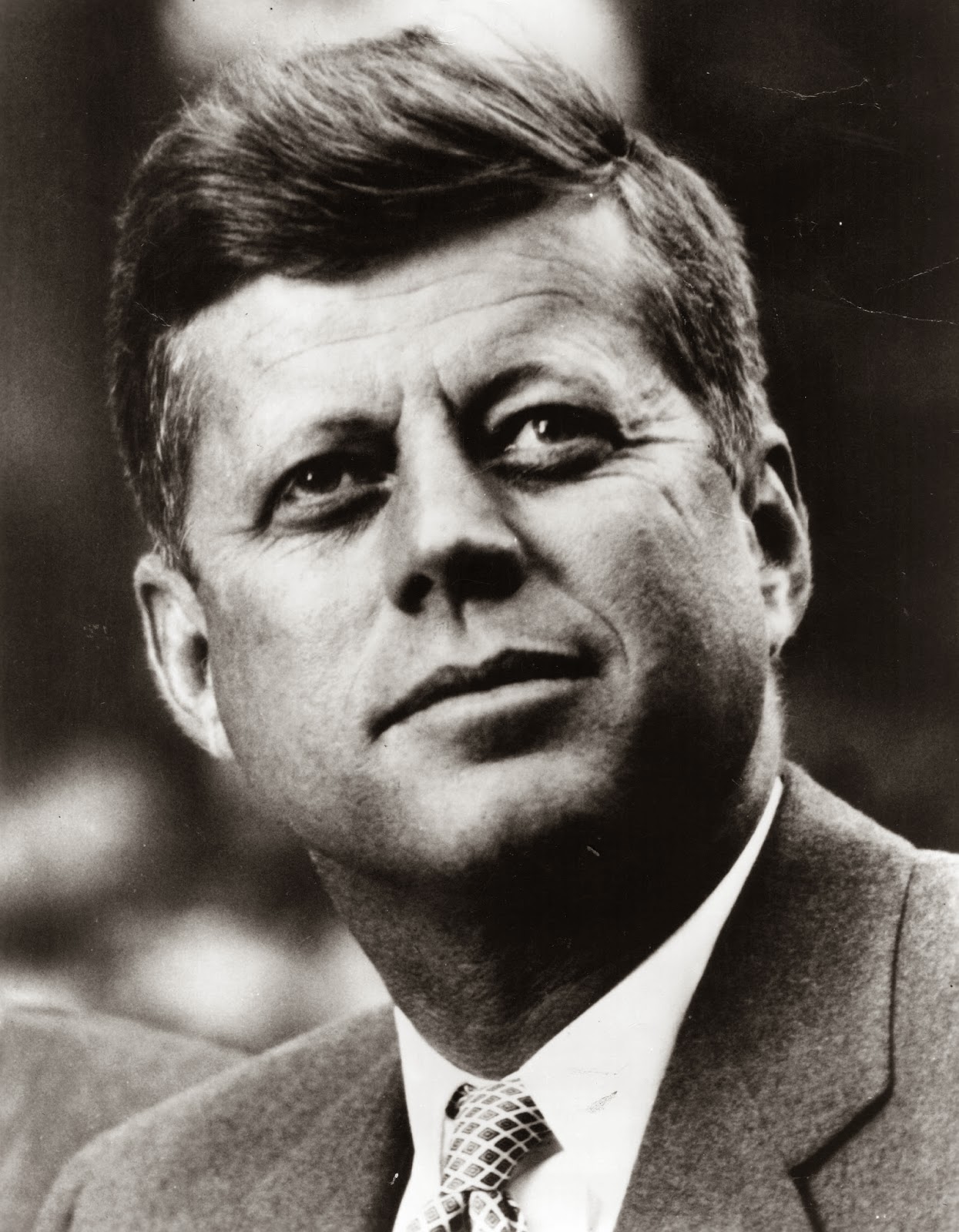
| John F. Kennedy, 1917-1963 |
 |
| November 25, 1963 |
I've long been fascinated by the assassination of President John F. Kennedy in Dallas, TX on November 22, 1963, an event that is receiving lots of attention this month on its fiftieth anniversary. I've read numerous books on the subject and consider myself fairly well-versed in most aspects of the case. (I actually have vague memories of the events as they were covered on television, though I was only four years old at the time.) The killing of Kennedy, of course, gave rise to all sorts of conspiracy theories, to which several factors contributed heavily. One, the doctors who performed the autopsy on Kennedy's body botched several aspects of the post-mortem, especially the track of the first bullet that hit him. (They initially failed to consider that the exit wound might have been obliterated by the tracheotomy that the ER doctors in Dallas performed on him.) Two, Lee Harvey Oswald, the presumptive assassin, was himself gunned down two days later while in the Dallas PD's custody. The police's negligence in guarding Oswald while moving him from the police station to the county jail quite understandably gave rise to suspicions that it was a contract killing to "silence" him.
Three, the notion that a single bullet could pass through Kennedy and cause all of Governor John Connally's wounds, all without fragmenting, seemed fantastical to many people. And, absent that explanation, there necessarily had to have been multiple gunmen and, by definition, a conspiracy. Four, as others have pointed out, the idea that an inconsequential person like Oswald could murder the president of the United States, without help, created a psychological need on many people's part to rationalize the deed by imagining it was the product of some large-scale, nefarious plot. Five, most people assumed from the start -- especially since the assassination happened in a conservative city in a southern state -- that the attack came from the "environment of hate" on Kennedy's political right. That the attack actually came from his political left just didn't fit in the heads of a lot of people. And, last, for most people Oswald didn't appear to have a clear motive to kill Kennedy; after all, why would an avowed Marxist shoot at a liberal Democrat (a popular image of Kennedy that has only deepened over time)? However, as many have pointed out, Kennedy was a committed anti-communist, and reportedly his administration had for some time been trying to assassinate Fidel Castro. Is it really that far-fetched to believe a Castro supporter would want to kill him?
I have generally been inclined to accept the conclusions of the Warren Commission, in large part due to Occam's Razor -- and Oswald's having been the lone assassin is easily the simplest explanation of the killing. There are many indicia of his guilt (although, of course, in the fever swamp of conspiracy-theorist brains, those indicia merely serve to highlight how complex and far-reaching the "plot" to get Kennedy really was).
One, there is little reason to doubt that Oswald owned the rifle used in the assassination, and he had taken in to work that day a parcel wrapped in brown paper that was roughly the size of the rifle when disassembled. Two, ballistics tests later suggested that the Oswald rifle had been used in an attempt to assassinate retired Major General Edwin Walker, a right-wing political figure in Texas, in April 1963. No one seems to dispute much that Oswald pulled the trigger on Walker, who was spared only because the bullet hit a window frame and was deflected. Three, multiple people in Dealey Plaza saw someone of Oswald's description in the corner sixth-story window of the Texas School Book Depository prior to the shooting. The fact (a) that two people watching the presidential motorcade from the fifth-floor window below heard three shots, the repeated operation of the bolt action of the weapon, and the spent shell casings hitting the floor above them, (b) that multiple witnesses on the ground saw the rifle barrel sticking out of the window as the shots were being fired, and (c) that three shell casings were later found in the sniper's nest are pretty conclusive evidence that shots were, indeed, fired from the sixth-floor window.
Four, Oswald left his workplace at the Book Depository almost immediately after the shooting and was the only employee not accounted for that afternoon. Five, in what David Belin, an assistant counsel to the Warren Commission, called the "Rosetta Stone" to solving the Kennedy assassination, Oswald killed Officer J.D. Tippit of the Dallas PD. I know Oliver Stone (in his film JFK) portrayed the proof of Oswald's guilt in the Tippit murder as shaky and inconclusive at best, but he had to ignore completely the overwhelming weight of the eyewitness testimony and other evidence to do so. There simply isn't any reasonable doubt that Oswald killed Tippit, which begs the question that Belin posed: Why would Oswald kill a police officer if he hadn't already shot the president?
Finally, although there are no verbatim transcripts of Oswald's questioning during the two days he was in police custody, by all accounts he was smug, arrogant, and evasive the entire time. In short, he didn't act like a person who was being framed for something he didn't do; rather, his demeanor was that of the proverbial cat that swallowed the canary.
As for evidence of a conspiracy, well, I'll say this. There is no compelling evidence that any of the bullets hitting inside the presidential limousine came from any direction but the right rear of the car. The words "back and to the left" have become a mantra for people who insist the fatal head shot came from the front; however, Frame 313 of the Zapruder film clearly shows blood and brain tissue coming out the front half of Kennedy's skull, indicative of a shot from the rear. Who can say what a human body will do after a bullet takes out half of the person's brain -- especially a person wearing a back brace? Thus I agree that the "back and to the left" motion of Kennedy's body is easily explained as a neuromuscular reaction to the devastating brain injury he suffered. The "magic bullet" that passed through Kennedy's neck and hit Governor Connally was hardly supernatural; the 3-D renderings that people have done recently of pertinent frames from the Zapruder film satisfy me that the bullet didn't have to "zig-zag" through the air to cause all the wounds. The bullet, though it didn't fragment, still was significantly deformed—flattened along its length—when it was found on the stretcher Connally had occupied at the hospital after the shooting. And the fact that Connally was struck in the back by a tumbling bullet is proof that it had passed through something before it hit him -- and what could that possibly have been if not President Kennedy?
[Update 12/21/19: I’ve recently become aware that one or more doctors at Parkland Hospital in Dallas who were involved in the futile efforts to save President Kennedy on 11/22/63–and, if I remember correctly, an x-ray technician at Bethesda Naval Hospital (where the autopsy was done)—continued to insist to their dying day that Kennedy’s gaping head wound was located in the rear (occipital region) of his skull. If there were credible evidence of a frontal entrance wound, this would be it; however, to believe these doctors (and the x-ray technician) requires the conclusion that the autopsy photos and x-rays were faked, pretty much on the fly. If Occam’s Razor undercuts any part of the various outlandish JFK assassination conspiracy theories, it is that the post-mortem photographic/radiographic evidence was fabricated. The much-simpler explanation is simply that these people were mistaken or were outright lying.]
Did Jack Ruby, Oswald's killer, have mob connections? Maybe, but his actions after Kennedy was killed show to my satisfaction that the man was mentally unbalanced and almost uncontrollably prone to acting on impulse. (The evidence also shows that Ruby's presence in the basement of the police station, at the precise moment Oswald was brought out, was an amazing coincidence, but a coincidence nonetheless.) He simply wasn't the kind of man an intelligent mob boss would hire to do a "hit" on Oswald. But he was the kind of man who was stupid enough in the moment to think he'd be hailed as a hero for killing the president's assassin -- that he'd spend a day or two in police custody before being set free -- when all he really accomplished was to get himself locked up for life and to give birth to a thousand conspiracy theories.
Was Oswald acting on anyone's orders? Mary Anastasia O'Grady of the Wall Street Journal believes that Fidel Castro may well have known about Oswald's intent to shoot Kennedy, and that Oswald, whose application for a visa to enter Cuba (submitted at the Cuban consulate in Mexico City only a few weeks before the Kennedy assassination) had been rejected, may have been motivated by a desire to establish his Marxist-revolutionary bona fides to the Cuban government. (On the other hand, it isn't clear that Oswald ever had much hope of getting away, as he didn't appear have an escape plan to speak of.) O'Grady, however, doesn't believe Castro, who probably knew the U.S. government had been trying to kill him, specifically ordered Oswald to kill President Kennedy. I agree -- who would have sent an unstable neurotic like Oswald on such a mission, even if one were rooting for the end result?
Thus we may never know if Oswald had specific connections to the Cuban government. Many of the people who believe in a conspiracy are the ones least likely to suspect Castro of complicity in the assassination, or even to investigate the possibility thereof. After all, President Kennedy was, and especially is now, the darling of the liberal left; it's simply inconceivable to them that one of their heroes, Castro, could have wanted to take out their patron saint, Kennedy.
In closing, I'll make a few comments about John F. Kennedy the man. We know now what most of the American public didn't know about Kennedy while he was president -- namely (a) that his health was extremely tenuous and could have turned grave at any moment, and (b) that he was wildly, recklessly, even predatorially promiscuous (particularly in the case of his affair with 19-year-old White House press-office intern Mimi Alford, on whom, by her recent account, he essentially forced himself in their first liaison in his wife's bedroom). His sexual conquests only enhance his image as far as his current-day admirers are concerned, but, back in the day, there was a lot about him that had to be kept secret in order to get him elected and then to keep him in office. Bill O'Reilly believes, notwithstanding Kennedy's many infidelities, that the latter genuinely loved his wife Jackie, and I'm willing to grant him that.
Kennedy also took some pretty conservative positions on foreign-policy and economic issues of the day. (In the light of history, he clearly was correct on civil rights for people of color.) Those positions were hardly outside of the mainstream for a Democrat of that era; it was only later in the 1960s that the Democratic Party tacked "hard-a-larboard," and some people think JFK's murder was the primary catalyst for the America-hating mindset from which arose the modern political Left in this country. (It was no coincidence that various conservative Democrats, including John Connally himself, became Republicans in the 1970s.) The question I ask myself about JFK, not to mention Martin Luther King, Jr. and Bobby Kennedy, is where his politics would have ended up had he lived. Would he have remained moderate, or would he have become an arch-liberal like his younger (and much-duller) brother Teddy? We’ll obviously never know.
[Update 12/19/13: I came across this photo of JFK and Jackie, taken after they arrived at Love Field in Dallas on November 22, 1963. It's striking for the vibrant colors of Mrs. Kennedy's suit and the roses that had been handed to her -- and for the knowledge in hindsight that, inside of an hour, JFK would be dead and that pink suit would be stained with his gore.]

[Update 2/27/14: This National Geographic documentary paints a very poignant picture of the last hours of President Kennedy's life, as seen through the camera lens and in the memories of various people who saw him and Mrs. Kennedy and shook their hands I don't know how long it will stay up on Youtube, but it's worth watching multiple times.]
[Embedded video deleted from YouTube.]
Three, the notion that a single bullet could pass through Kennedy and cause all of Governor John Connally's wounds, all without fragmenting, seemed fantastical to many people. And, absent that explanation, there necessarily had to have been multiple gunmen and, by definition, a conspiracy. Four, as others have pointed out, the idea that an inconsequential person like Oswald could murder the president of the United States, without help, created a psychological need on many people's part to rationalize the deed by imagining it was the product of some large-scale, nefarious plot. Five, most people assumed from the start -- especially since the assassination happened in a conservative city in a southern state -- that the attack came from the "environment of hate" on Kennedy's political right. That the attack actually came from his political left just didn't fit in the heads of a lot of people. And, last, for most people Oswald didn't appear to have a clear motive to kill Kennedy; after all, why would an avowed Marxist shoot at a liberal Democrat (a popular image of Kennedy that has only deepened over time)? However, as many have pointed out, Kennedy was a committed anti-communist, and reportedly his administration had for some time been trying to assassinate Fidel Castro. Is it really that far-fetched to believe a Castro supporter would want to kill him?
I have generally been inclined to accept the conclusions of the Warren Commission, in large part due to Occam's Razor -- and Oswald's having been the lone assassin is easily the simplest explanation of the killing. There are many indicia of his guilt (although, of course, in the fever swamp of conspiracy-theorist brains, those indicia merely serve to highlight how complex and far-reaching the "plot" to get Kennedy really was).
One, there is little reason to doubt that Oswald owned the rifle used in the assassination, and he had taken in to work that day a parcel wrapped in brown paper that was roughly the size of the rifle when disassembled. Two, ballistics tests later suggested that the Oswald rifle had been used in an attempt to assassinate retired Major General Edwin Walker, a right-wing political figure in Texas, in April 1963. No one seems to dispute much that Oswald pulled the trigger on Walker, who was spared only because the bullet hit a window frame and was deflected. Three, multiple people in Dealey Plaza saw someone of Oswald's description in the corner sixth-story window of the Texas School Book Depository prior to the shooting. The fact (a) that two people watching the presidential motorcade from the fifth-floor window below heard three shots, the repeated operation of the bolt action of the weapon, and the spent shell casings hitting the floor above them, (b) that multiple witnesses on the ground saw the rifle barrel sticking out of the window as the shots were being fired, and (c) that three shell casings were later found in the sniper's nest are pretty conclusive evidence that shots were, indeed, fired from the sixth-floor window.
Four, Oswald left his workplace at the Book Depository almost immediately after the shooting and was the only employee not accounted for that afternoon. Five, in what David Belin, an assistant counsel to the Warren Commission, called the "Rosetta Stone" to solving the Kennedy assassination, Oswald killed Officer J.D. Tippit of the Dallas PD. I know Oliver Stone (in his film JFK) portrayed the proof of Oswald's guilt in the Tippit murder as shaky and inconclusive at best, but he had to ignore completely the overwhelming weight of the eyewitness testimony and other evidence to do so. There simply isn't any reasonable doubt that Oswald killed Tippit, which begs the question that Belin posed: Why would Oswald kill a police officer if he hadn't already shot the president?
Finally, although there are no verbatim transcripts of Oswald's questioning during the two days he was in police custody, by all accounts he was smug, arrogant, and evasive the entire time. In short, he didn't act like a person who was being framed for something he didn't do; rather, his demeanor was that of the proverbial cat that swallowed the canary.
As for evidence of a conspiracy, well, I'll say this. There is no compelling evidence that any of the bullets hitting inside the presidential limousine came from any direction but the right rear of the car. The words "back and to the left" have become a mantra for people who insist the fatal head shot came from the front; however, Frame 313 of the Zapruder film clearly shows blood and brain tissue coming out the front half of Kennedy's skull, indicative of a shot from the rear. Who can say what a human body will do after a bullet takes out half of the person's brain -- especially a person wearing a back brace? Thus I agree that the "back and to the left" motion of Kennedy's body is easily explained as a neuromuscular reaction to the devastating brain injury he suffered. The "magic bullet" that passed through Kennedy's neck and hit Governor Connally was hardly supernatural; the 3-D renderings that people have done recently of pertinent frames from the Zapruder film satisfy me that the bullet didn't have to "zig-zag" through the air to cause all the wounds. The bullet, though it didn't fragment, still was significantly deformed—flattened along its length—when it was found on the stretcher Connally had occupied at the hospital after the shooting. And the fact that Connally was struck in the back by a tumbling bullet is proof that it had passed through something before it hit him -- and what could that possibly have been if not President Kennedy?
[Update 12/21/19: I’ve recently become aware that one or more doctors at Parkland Hospital in Dallas who were involved in the futile efforts to save President Kennedy on 11/22/63–and, if I remember correctly, an x-ray technician at Bethesda Naval Hospital (where the autopsy was done)—continued to insist to their dying day that Kennedy’s gaping head wound was located in the rear (occipital region) of his skull. If there were credible evidence of a frontal entrance wound, this would be it; however, to believe these doctors (and the x-ray technician) requires the conclusion that the autopsy photos and x-rays were faked, pretty much on the fly. If Occam’s Razor undercuts any part of the various outlandish JFK assassination conspiracy theories, it is that the post-mortem photographic/radiographic evidence was fabricated. The much-simpler explanation is simply that these people were mistaken or were outright lying.]
Did Jack Ruby, Oswald's killer, have mob connections? Maybe, but his actions after Kennedy was killed show to my satisfaction that the man was mentally unbalanced and almost uncontrollably prone to acting on impulse. (The evidence also shows that Ruby's presence in the basement of the police station, at the precise moment Oswald was brought out, was an amazing coincidence, but a coincidence nonetheless.) He simply wasn't the kind of man an intelligent mob boss would hire to do a "hit" on Oswald. But he was the kind of man who was stupid enough in the moment to think he'd be hailed as a hero for killing the president's assassin -- that he'd spend a day or two in police custody before being set free -- when all he really accomplished was to get himself locked up for life and to give birth to a thousand conspiracy theories.
Was Oswald acting on anyone's orders? Mary Anastasia O'Grady of the Wall Street Journal believes that Fidel Castro may well have known about Oswald's intent to shoot Kennedy, and that Oswald, whose application for a visa to enter Cuba (submitted at the Cuban consulate in Mexico City only a few weeks before the Kennedy assassination) had been rejected, may have been motivated by a desire to establish his Marxist-revolutionary bona fides to the Cuban government. (On the other hand, it isn't clear that Oswald ever had much hope of getting away, as he didn't appear have an escape plan to speak of.) O'Grady, however, doesn't believe Castro, who probably knew the U.S. government had been trying to kill him, specifically ordered Oswald to kill President Kennedy. I agree -- who would have sent an unstable neurotic like Oswald on such a mission, even if one were rooting for the end result?
Thus we may never know if Oswald had specific connections to the Cuban government. Many of the people who believe in a conspiracy are the ones least likely to suspect Castro of complicity in the assassination, or even to investigate the possibility thereof. After all, President Kennedy was, and especially is now, the darling of the liberal left; it's simply inconceivable to them that one of their heroes, Castro, could have wanted to take out their patron saint, Kennedy.
In closing, I'll make a few comments about John F. Kennedy the man. We know now what most of the American public didn't know about Kennedy while he was president -- namely (a) that his health was extremely tenuous and could have turned grave at any moment, and (b) that he was wildly, recklessly, even predatorially promiscuous (particularly in the case of his affair with 19-year-old White House press-office intern Mimi Alford, on whom, by her recent account, he essentially forced himself in their first liaison in his wife's bedroom). His sexual conquests only enhance his image as far as his current-day admirers are concerned, but, back in the day, there was a lot about him that had to be kept secret in order to get him elected and then to keep him in office. Bill O'Reilly believes, notwithstanding Kennedy's many infidelities, that the latter genuinely loved his wife Jackie, and I'm willing to grant him that.
Kennedy also took some pretty conservative positions on foreign-policy and economic issues of the day. (In the light of history, he clearly was correct on civil rights for people of color.) Those positions were hardly outside of the mainstream for a Democrat of that era; it was only later in the 1960s that the Democratic Party tacked "hard-a-larboard," and some people think JFK's murder was the primary catalyst for the America-hating mindset from which arose the modern political Left in this country. (It was no coincidence that various conservative Democrats, including John Connally himself, became Republicans in the 1970s.) The question I ask myself about JFK, not to mention Martin Luther King, Jr. and Bobby Kennedy, is where his politics would have ended up had he lived. Would he have remained moderate, or would he have become an arch-liberal like his younger (and much-duller) brother Teddy? We’ll obviously never know.
[Update 12/19/13: I came across this photo of JFK and Jackie, taken after they arrived at Love Field in Dallas on November 22, 1963. It's striking for the vibrant colors of Mrs. Kennedy's suit and the roses that had been handed to her -- and for the knowledge in hindsight that, inside of an hour, JFK would be dead and that pink suit would be stained with his gore.]

[Update 2/27/14: This National Geographic documentary paints a very poignant picture of the last hours of President Kennedy's life, as seen through the camera lens and in the memories of various people who saw him and Mrs. Kennedy and shook their hands I don't know how long it will stay up on Youtube, but it's worth watching multiple times.]
[Embedded video deleted from YouTube.]

.jpg)


.jpg)
.jpg)